Timeline for Thomas Saunders (1513-1565) of London and Charlwood, Surrey

The following timeline was extracted from The History of Parliament, British Political, Social & Local History: the House of Commons 1509-1558

1513

Thomas Saunders born this year or previously, as the oldest surviving son of Nicholas Saunders of Charlwood and Alice, daughter of John Hungate of Yorkshire (Saxton?)

1527

Thomas Sanders educated at 1 Temple

1539

Thomas Saunders is married to Alice, daughter of Sir Edmund Walsingham of Scadbury, Chislehurts, Kent (settlement 6 june)

Before succeeding his father at Charlwood in August 1553 Thomas Saunders had himself acquired the manors of Flanchford and Hartswood in 1539 and in the following year had had three manors in Sanderstead and Warlingham settled on him by his father on his marriage to Alice Walsingham.

1540

Thomas Saunders is solicitor to the houshold of Queen Anne of Cleves and of Queen Catherin Howard

1541-1558

Thomas Saunders is Justice of the Peace

1542

Thomas Saunders sat in the Commons under three successive monarchs and at intervals over a span of 16 years. His return for Gatton to the Parliament of 1542 he must have owed to Sir Roger Copley, described in the indentures as ‘burgess and only inhabitant of the borough’, but whether as Copley’s near neighbour at Charlwood or through an intermediary like Copley’s father-in-law (Sir) William Shelley it is impossible to say. In the first session he shared in the passing of the Act (33 Hen. VIII, c.21) attainting his mistress the Queen.

1543

In 1543 Thomas Saunders took a 21-year lease of a house in the Blackfriars, which presumably became his London residence; from 1550 his landlord there was his Surrey neighbour Cawarden. This transaction apart, Saunders did not interest himself in monastic property.

1546

Attendent on Lent reader, Inner Temple; Summer reader 1546; autumn reader 1546, 1547,

Thomas Saunders’ long upward progress there received occasional checks: his refusal to read in the summer of 1547 cost him temporary demotion from the bench

Appointed solicitor of the Queen’s household in 1540, originally for Anne of Cleves but then for Catherine Howard, he obtained the reversion of the office of King’s remembrancer in 1545 and the office itself in 1549. Its previous holder was (Sir) Christopher More, a fellow Inner Templar who had settled in Saunders’s own county; in February 1547 Saunders indemnified More against any harm resulting from his visits to the Exchequer ‘to see and peruse the records and process there for his learning and knowledge of the course of the said office’. He was to retain the post until his death. Similar continuity marked Saunders’s record in local administration: for the last 24 years of his life he served every regime in turn.4

1548

Thomas Saunders is commr. chantries Surrey, Sussex and chantries Surrey, Sussex and Chichester

1549

Thomas Saunders, Kings remembrances, the Exchequer

1550

Thomas Saunders, relief, Surrey and Sussex.

Thomas Saunders’ knighted.

1552

Whether he unsuccessfully sought a seat at the two following elections is not known, but when on 1 Feb. 1552 the Council sent a writ for the election of a knight for Surrey to replace either Sir Christopher More, or more probably More’s successor, it was accompanied by an instruction to the sheriff, Sir Robert Oxenbridge, to ‘prefer’ Saunders.

This may well have been done on the initiative of William Paulet, 1st Marquess of Winchester: as treasurer, Winchester was Saunders’s departmental chief, and he had probably engineered Saunders’s knighthood in 1550 shortly after his own promotion. In the event the Council’s recommendation was ignored and the sheriff returned John Vaughan I. Twelve months later the Council prepared to intervene again; this time it favoured the re-election of Vaughan and the other previous Member Sir Thomas Cawarden, but whereas Cawarden was chosen Vaughan was passed over in favour of Saunders. What lay behind this reversal can only be guessed at: the implied assertion of shire independence may have been more apparent than real and the explanation lie in an amicable adaptation to circumstances.5

Saunders was not to regain the knighthood of the shire until 1558; at three of the intervening elections it was his ultra-Catholic cousin William Saunders who replaced him, once during Saunders’s shrievalty. Still he was elected for Reigate, where his patron was probably the lord of the manor, Lord William Howard from whom he held property there. Unlike some other Members from Surrey he did not oppose the initial measures for the restoration of Catholicism, and it was in the course of the second session that he was pricked sheriff. He had presumably won the Queen’s confidence by ignoring the attempt of the Council, as soon as Edward VI was dead, to secure Surrey for Jane Grey, and his conduct during Wyatt’s rebellion justified his choice. The invidious duty of sequestering Cawarden’s goods and, with William Saunders, of removing Cawarden’s weapons he appears to have carried out efficiently but humanely, afterwards sending Lady Cawarden a letter of apology and ‘a token of your own’, and he may not have been wholly to blame for the failure to return all the goods with which Cawarden was later to charge him.6


1553

Thomas Saunders father dies, leaving him heir to extensive property in Surrey.  Both his great uncle the father of William Saunders and his uncle Wiliam, the father of Nicholas Saunders the Catholic controversialist, may have been members of other inns, but he established the family’s connexion with the Inner Temple, where on his admission in 1527 he was pardoned all vacations and offices and allowed to be out of commons at his pleasure.

Thomas Saunders, goods of churches and fraternities, Surrey

Sherriff, Surrey and Sussex, 1553-54

1556-8

Thomas Saunders is Treasurer; and governor in 1557

1557

Thomas Saunders, musters, conventicies

1558

Wife Alice Walsingham dies

1560

Thomas Saunders’  work as treasurer was challenged and he was called upon to re-account. No such setbacks appear in his government career.

1563

Thomas Saunders dies.

His legal standing made him a suitable choice as an overseer of wills, and among those who named him in this capacity were his father-in-law Walsingham and one of his successors as Member for Gatton, John Tingleden. Saunders’s own will, which he drew up himself, was meticulous in its provisions and requirements. His wife was to have a life interest in most of his property but if she remarried she would have to give the heir written sureties against despoiling of woods or furnishings; the rest of the property was divided among the younger children. Anxious that at least one of his sons should study law, Saunders promised his law books to whichever of them did so. His care for learning showed itself in his ample provision for ‘an honest parish clerk at Charlwood that can play the organ and teach children, for maintenance of God’s service’, and the bequest of his ‘books of humanity and stories in Latin or French’ to his own children. Although he made the will on 7 Mar. 1563, Saunders did not die until 18 Aug. 1565, probate following on 7 July 1566.7

Posted in SAUNDERS | Comments Off on Timeline for Thomas Saunders (1513-1565) of London and Charlwood, Surrey

Timeline for Edward Saunders (1595-1639) of Charlwood, Surrey and Virginia in early 17th century

WHB -I have constructed a timeline relating to Edward Saunders of Charlwood, Surrey, based on the notes of Justin Sanders.

1595

Edward Sr. was born about 1595 in Charlwood, Surrey County, England.

Edward Saunders is believed to be the person who, at age 40, sailed on the ship Safety from London to Virginia, and who, in 1635, was listed as the father of passengers Thomas, 13 and Edward Jr., age 9.

1607

Thomas Saunders (who ran Joseph Saunders warehouse in the late 1640’s) was born in Gloucester, England in 1607, the son of Philip Saunders of Amroth, Wales, a descendent of the same Charlwood, Surrey County Sanders/Saunders family from which Edward is believed to descend.

1619

Edward  Saunders made his first voyage to Jamestown in 1619 as a merchant working within the Virginia Company, and returned to England in 1621. he name of his father is not known, but he is thought to be a grandson of Thomas White Saunders of Charlwood.

1622

Edward Saunders may have been absent when his first son, Thomas, was born in England in 1622.

In 1622 Edward and Roger Saunders divided their time between Jamestown and Accomack, a possible reason they escaped the massacre. “Together over the next decade Edward and Roger assisted others in managing the lands of cattle of Lady Dale, the ex-governor’s wife. . . .”

1623

A legal paper filed in London in 1623 identified Edward as an inhabitant of the colony when an Indian massacre took the lives of 347 colonists (about one-fourth of the population) on 22 March 1622.

1624

Edward Saunders  was back in England at the time the paper was filed, attesting  to conditions in Jamestown at the time of the attack. He therefore played a role in the dismantling of the Virginia Company in 1624, at which time Virginia became a Crown Colony. [Ralph Sanders, Generations: A Thousand Year Family History, p. 191].

On his return to Virginia in 1622 Edward was accompanied by a relative named Roger Saunders. The two men collaborated in a warehouse venture with Joseph Saunders, a wealthy ship owner and merchant of the ancient Vintners Company.

A relationship between Edward and Joseph is suspected, but has not been identified. The warehouse of Joseph Saunders was located near Cape Charles in Accomack, somewhere near the southern tip of the peninsula where Roger Saunders constructed a plantation house in 1628.

1625

Between 1625 and 1635 the Saunders Accomack Virginia warehouse imported linen, powder and wine in exchange for tobacco and beaver skins. [p. 198].

1628

Roger Saunders consturcts a plantation house near Cape Charles in Accomack

1632

Roger Saunders managed the Accomack warehouse until his death in 1632. William Smith then took over the operation until his death in 1636.

1635

4 July 1635 – the ship Transport, Edward Walker, Master, embarked for Virginia from London.

Thomas Saunders – 20.

Source: John Camden Hotten, The Original Lists of Persons of Quality . . . 1600-1700, p. 102.

10 Aug 1635 – the ship Safety, John Graunt, Master, embarked from London carrying 144 persons to Virginia.

Edward Saunders – 40

Thomas Saunders – 13

Edward Saunders – 9.

James Pattison – 21 (listed two names above the senior Edward).

Source: John Camden Hotten, The Original Lists of Persons of Quality . . . 1600-1700, p. 122.

The Edward Saunders above, age 40, was the father of Thomas, 13 and Edward Jr., age 9. Edward Sr. was born about 1595 in Charlwood, Surrey County, England.

[Note from WHB – See my previous posts Ancestral Families and the English-Colonial Trade (1612-1632) and Saunders in Gloucestershire and Bristol in Late Medieval Times.]

1636

William Smith (of Accomack warehouse) death in 1636.

1639

Edward Saunders ran operations at the Accomack warehouse until he and three coworkers died in 1639 aboard the Flower de Luce, a ship owned by Joseph Saunders, en route for England [p. 199]. “. . .

Thomas Saunders of Gloucester (not the son of Edward) evidently picked up the slack in the 1640’s after the deaths of earlier partners.” [Sanders, p. 197].

The sons of Edward Saunders, Thomas, b. 1622 and Edward, b. 1625 returned to England following the death of their father. In 1655 Edward returned to Virginia with the title of Doctor and resided in Northumberland County. His brother Thomas followed shortly after and obtained property nearby in the same county.  [Sanders, pp. 401-2].

The sons of Edward Saunders, Thomas, b. 1622 and Edward, b. 1625 returned to England following the death of their father.

1655

In 1655 Edward returned to Virginia with the title of Doctor and resided in Northumberland County. His brother Thomas followed shortly after and obtained property nearby in the same county.  [Sanders, pp. 401-2].


Posted in SAUNDERS | Comments Off on Timeline for Edward Saunders (1595-1639) of Charlwood, Surrey and Virginia in early 17th century

Conversations with Justin Sanders regarding English Connections of Sanders/Saunders Families of Virginia

I have been in communication with Justin Sanders of Phoenix, Arizona, who has successfully identified his direct line of ancestors back through 17th century Virginia and before that to London, England.

We have begun a process of comparing research and of sharing information about genealogical resources as well as sharing our y-DNA test results.  We invite comments from other researchers. (Contact me at [email protected].) WHB

A communication from Justin Sanders (Phoenix, AZ)

Bill,

I suppose the best place to open a dialogue about research would be with notes I collected on a Thomas Sanders of New Kent (later King & Queen) and his son of the same name. Attached is an essay regarding their records and origins, much of which was carved from Ralph Sanders work, Generations: A Thousand Year Family History.

Like so many of the early Sanders/Saunders persons in Virginia, Thomas came to the colony as an entrepreneur, he in the employ of the Vintners Company of London. Once I documented my earliest known ancestor as James Sanders of New Kent (1675-1717), Thomas Sanders was the first person I looked at in my search for earlier ancestors.

The name and location made him an obvious target. Speculation as to whether or not my line ties this person could be easily ended if Ralph Sanders had DNA results out there, somewhere. To date, I have not been able to locate him.

I am also attaching a note file on Sanders persons transported to the Middle Peninsula and Peninsula during the 17th Century. They are primarily abstracts taken from Cavaliers & Pioneers, Volumes 1 & 2. One I would like to highlight here is one I intended to include in my lengthy email earlier, regarding a possible connection to the son and neighbors of William Sanders who died in Charles City County, in 1660.

18 Feb 1673/4 – Wm. Sanders, Michael Edmonds, Cuthbert Tunstall transported  by Robt. Bagby & Wm. Hernden. New Kent Co., NE side of Mattapony River adj. Thos. Hall, Jno. Pigg, Source: Cavaliers & Pioneers, Vol. 2, p. 143. (PB6:502).

The William Sanders and Cuthbert Tunstall referenced here may be the sons of William Sanders Sr. (d. 1660) and Edward Tunstall, who owned adjoining patents on the Appomattox River circa 1640. It is possible a family connection between William Sanders and the Tunstalls. As you will see in the essay and note files, the northeast side of Mattapony Creek is where the above Thomas Sanders Senior and Junior resided, and an area to where a number of Sanders persons were transported (presumably) in the following decades.

Justin

Because of the richness of the data collected by Justin, I will organize it into separate web pages as appropriate, and will create hyperlinks between related pages (and, in specific cases, to my own research.)


Posted in SAUNDERS | Comments Off on Conversations with Justin Sanders regarding English Connections of Sanders/Saunders Families of Virginia

Quakers in Gloucestershire and Other Possible Ties with New Kent County VA

On March 6, I posted a “speculative genealogy” from Anthony Crump, based on various hints he received from ancestry.com forums etc. and other internet research. Although his summary of his findings is loosely documented, there are some clues to further research.

The first clue is the presence of what appear to be documentable ancestors in New Kent County, Virginia (Saint Peters parish) one of whom may have been born in the County of Gloucestershire, England. (I am descended from persons who lived in Gloucestershire.)

Because I also have ancestors whom I have documented in New Kent County I coded every page mentioning that county so that one can hit the category “New Kent County VA” on the side of the front-page to immediately access every corresponding reference.

One notes immediately that many of the persons who were associated with Saint Peters Parish (near the county line of Hanover County VA) came to be associated with the Quaker churches of Virginia.

A second clue suggests a new line of research –  identifying Thomas Crump as (possibly) from Westbury-on-Severn in Gloucestershire. What is striking about Westbury in Gloucester is that in 1668 at Westbury a Quaker community was established.

Westbury or Forest Monthly Meeting Westbury on Severn Society of Friends Formed: 1668.

I have discussed religious dissent in Gloucestershire (and adjoining counties of Southern England) on these pages. These include the religious dissent of Gloucestershire men surnamed Saunders (my ancestral surname), which is a closely related surname (i.e., with a Most Recent Common Ancestor likely within historical time) to Crump according to DNA studies conducted of myself and Anthony Crump.

One obvious subject for further research is to determine what the relationships might have existed between the Gloucestershire Society of Friends and those of Society of Friends of Virginia.


Posted in CARTER, GLOUCESTERSHIRE DOCUMENTS, NEW KENT COUNTY VA, SAUNDERS | Comments Off on Quakers in Gloucestershire and Other Possible Ties with New Kent County VA

A speculative ancestral history for Anthony Crump

The following excerpt is from a communication from Anthony Crump, who has developed an extensive genealogy based on sharing information with persons from ancestry.com and perusing such sources as the Victoria County Histories of England.

Although it is a rare occasion when the addition of “one more generation back” opens up an entire millennium of sons descending from fathers, it is not enirely implausible.

Anthony and I are related – rather closely according to the DNA testers, although it does appear to be certain that the Most Recent Common Ancestor was several centuries (or more) back in time.

The French Normans that invaded England in 1066 and thereafter were one of the groups of the past that were absorbed with the keeping track of ancestors. Even as laws and customs promoting primogeniture favored only the eldest male, descent from nobility and especially from kings was highly regarded (although the most coveted designation of being of “royal descent” virtually always descended through illegitimate lines).

Here is an extract from Anthony’s speculative genealogy, to which we will return in the future.

*****

I started [my genealogical research with] me then my father, my grandfather, my g-grandfather, and my gg-grandfather all of which I am certain are my relatives.

Then the journey was guided by documentation of census, land purchases, church records to include marriage, birth, death, etc. DNA tests have concluded that I am from the Crumps from New Kent Virginia.

The first seven generations were from Chesterfield, Virginia then they were from New Kent starting with Thomas Crump who was the eight generation born 1756 in New Kent, Virginia and went six more generations until William Crump who was from Kent, England born 1580.

William Crump was my 12th great grandfather. Then Roger Crump b 1552 Ludlow, Shropshire, England and my 14 great grandfather John Crump from Almer, Dorset, England born 1520. Then all of a sudden my surname changes to James Crompton, Crump, Crumpler, Crompe born 1502 Crompton, Lancashire, England.

The next three generations are all knights, Sir Piers VI De Crompton, Sir Richard II De Crompton and Sir Richard I De Crompton my 18th great grandfather. The family tree goes on until my 25 great grandfather Sir Piers De La Legh De Crompton born 1161.

The next generation does not show the name Crompton, the surname changes to DELALEGH and changes again to DEVENABLES.  Gilbert DEVANABLES was born Venables, Eure, Haute-Normandie, France and died Kinderton, Cheshire, England. 1093

 *****

I believe that the first order of business is to spend some time studying the history of New Kent County VA and of the ancestral families who resided there.  I am adding a New Kent County VA category tag to every person mentioned so far in association with that County.

Posted in NEW KENT COUNTY VA | Comments Off on A speculative ancestral history for Anthony Crump

MG’s Paper Researching Distant Ancestors in the Line of Paternal Descendancy

The following paper was prepared by a distant cousin (MG) who corresponds with me on y-DNA studies and is printed with his permission. The paper summarizes the current findings of DNA research as they relate to our branch of the human “family tree”. I will make reference to this paper in further posts on this website on this subject.

Ancestral DNA project

 I am participating in a DNA Ancestry project to trace & search my genetic genealogy with three Labs, one Canadian, a British and a US Lab for deep SNP testing, which specializes in DNA testing.

I have originally purchased kits for testing: one for paternal & the other for maternal origin testing. My ancestral DNA CDN provider was offering DNA general services including ancestral DNA. However, they do not offer any analysis/reports of your results. The same issue exist for other Labs. No analysis. They are all interested in doing the tests and, I suspect, it is to make a profit.

The British Lab did provide a narrative but it was so generic in nature, covering 4 UK countries only that it was totally useless for me has my roots are from Normandy. Some Labs go as far as, not posting the results at the public website, to prevent you from comparing your results to the database. This is done, I surmise, in order to entice you in ordering more tests. Now I concentrate on Y-DNA only with my latest request.

There are 3 DNA inheritance patterns:

1-Autosomal (autosome)

2-Y-DNA (male) and

3- mtDNA (female).

Not all DNA providers test for these or if they do, they charge separately. Some offer combinations. The testing for # of markers varies from Lab to Lab and so do the prices.

Using the original literature from my CDN DNA provider, it states that Y-DNA (58 Million pairs) is inherited along the paternal line (from father to son). Ancestral markers (mutation) can be found throughout the entire Y-DNA.

There are two types of ancestral markers:

1- Short Tandem Repeat (STR) and

2- Single Nucleotide Polymorphism (SNP) (pronounced snip).

STR markers have rapid mutation rate (changes occur every few generations) compared to SNPs, which have a much slower mutation rate (changes occur every few hundred years or more).

These two types of markers allow scientists to trace recent ancestry (from a few generations ago) by testing STRs, and to trace deep ancestry (from thousands of years ago) by testing SNPs.

The paternal side STR DNA markers are concentrated in the Y chromosome (inherited from father to son) contains 58 million pair bits of info, each of which is encoded by a base pair.

Geneticists have identified specific chromosome locations that can be used for testing and comparison. These unique locations are called markers and when they occur on the Y chromosome they are given the names starting with DYS.

At some Y chromosome locations, there are segments of base pairs that are repeated in the DNA. Markers with these types of repetitions are called STR markers and are subject to rapid mutation. Example at the DYS391 location markers, TCTA (DNA chemicals A,T,C,G) is repeated 10 times. The # of repeats is the value that is shown on the Y-DNA test reports for the markers. Some markers are duplicate markers since they have two values Ex: DYS385a and DSY385b.  Others have more DYD464 has 5.

The next set is the SNP markers which has a much lower mutation rate (changes occur every few 100 yrs). The SNP markers are single changes in precise points of the DNA. Once a mutation occurs, it acts as an ancestral time date marker and all further generations will always carry that marker. Each SNP mutation that we carry allows us to trace our ancestry to a specific time and place in history.

The mtDNA markers are inherited along the maternal line (mother to child but it is retained and past along if it is daughter). From mother >daughter>daughter and so on. The mtDNA is divided into 3 regions. They are the coding region (00577-16023) and two hyper-variable regions HVR1 (16204-16569) and HVR2 (00001-00576).The entire mtDNA is 16,659 pairs (nucleotides) in length (1 to 16,569 base pairs). The mtDNA SNPs total approximately 3,000.

If you decide to request testing kits, request the highest # of paternal markers at the same time and the SNP tests. For the maternal tests, do the mtDNA (HVR-1 and HVR-2) first because that would be different to mine (different mothers). You then could consider later the SNP mtDNA test later.

My personal ancestral DNA

A Haplogroup (HP) defines where you fit in the Human genome tree. Letters and numbers are use to differentiate people. It also helps with understanding the population movement (migration) throughout the various regions of the world taken by our ancestors. It is a different route for males and females. If you test positive at specific SNP markers, you are in Y-HP I* or mtDNA-H*.

My original predicted Y-DNA Haplogroup was the Y-HP-“I1a” using my DYS455=8. The Haplogroup “I” is a branch which descended from Haplogroup “F” ancestors. Individuals belonging to the Haplogroup “I” carry the M89+ and the M213+ SNP markers of Haplogroup “F” and are further characterized by additional markers in the Y-DNA called M170+, M168+, M258+, M253+. The presence of the M170+ marker is unique to all individuals who descended from this line HP “I”. Now, with more SNPs testing done in 2015, I am no longer “I1a” but rather I-M253+,I-M253* and I-Z132+.

The founder of Haplogroup “I” lived approx. 15,000-20,000 years ago possibly in the Balkans (ancient Greece) during the last Glacial Maximum. He is a direct descendent of Haplogroup “F” ancestors who journeyed from the Middle East into the Balkans.

Today, the highest frequencies of Haplogroup “I” is found in the Balkans near the Dinaric Mountain chain in Croatia. Haplogroup “I” is strongly associated with Croat population namely Slavic people living in Croatia, Bosnia and Herzegovina and other nearby countries.

As the ice sheets retreated at the end of the Ice Age, these ancestors continued their journey northward Europe, in particular Scandinavia (a region in Northern Europe named after Scandinavian Peninsula). Today, a large portion of Scandinavian populations in the Adriatic regions, including Denmark, mainland Norway, Sweden and Finland trace their ancestry to this line. The Vikings are likely descendents from this line. The detection of low frequencies of this Haplogroup on the British Isles, France and some Celtic populations may be the results of more recent Vikings raids in these regions.

The association between Haplogroup “I” and Celtic culture is consistent with the parallels seen between the observed spread oh Haplogroup “I” in Western Europe and the corresponding Celtic expansion that occurred in the mid-first millennium BC. HP “I1” is estimated (in 2013) to be 4,000 to 5,000 years old. Now in 2015, it could be 8,000 to 10,000 years old.

Sub-types/clades of Haplogroup “I” include:

  • I 1 a – found at highest frequencies in Scandinavia, Iceland, and northwest Europe.
  • I 1 b – highly concentrated in Greece and other areas of Southern Europe.
  • I 1 c
  • I 2

Despite its apparent designation as “I “, subgroup”I”1a – with its “I”1b, 1c neighbours – have been shown to be of non-Scandinavian origin. Its roots have been traced to as recently as the past 1,000 years, and are thought to be linked to Anglo-Saxon migrations from southern into northern Europe. The group’s modern-day seat is in central Europe. See

“I”1a: The Haplogroup “I”1a lineage likely has its roots in northern France. Today it is found most frequently within Viking / Scandinavian populations in northwest Europe and has since spread down into Central and Eastern Europe, where it is found at low frequencies. See

I tested my personal Y-DNA markers at various sites including my DNA service provider and found no real comparison. Maybe there is no comparison available in North America as my ancestor originated, in 1643, from Dieppe, Normandie, France.

Those markers confirmed that my ancestors were part of the Haplogroup “I” (HG I) which was founded possibly in the Balkans (ancient Greece) 15,000-20,000 years ago during the last Glacial Maximum.

My paternal main Haplogroup is Y“I-M253+.

The HP I-M253+ had two branches until recently. The SNP markers represented by DF29+ (HP I1a) >Z58+ (HP I1a2), Z131+ (HP I1b) and S438+ (HP I2). With my results, there is a new separate branch I-Z132+. The branch Z132+ is estimated to be 8,000 to 10,000 years old.

The geographic location may be Northern France in the caves (some 36,000 years old) near Dieppe, Normandy, unless deep SNP ancestry tests reveals an older location, the ethnic group has not been determined yet.

The mtDNA is inherited along the maternal line (mother to child) and hold the key to the mysteries of our maternal ancestry. If the mtDNA is passed on to a son, it will end there. If it is passed on to a daughter, then the daughter-daughter will transfer it to the next generation.

My mtDNA SNP results states that my ancestral maternal ancestors were part of HG “mtDNA H”. However, the HG “H” has 90 subgroups many in EU. The British Lab labelled mine as mtDNA-Pioneer H86 based on one additional SNP marker they found T1809C. No explanation given for Pioneer. The CDN Lab prediction is incorrect at mtDNA H26.

In my research, I found an article that associated the migration of Y I-M253+ with the migration of mtDNA H. In other words, the wives traveled with their men on their voyage.

Therefore, all male “G” should share the same STR and SNP Y-DNA markers unless there is a substitution, an insertion or mutation.

With respect to the mtDNA markers, the outcome is totally different for all of you. My own mtDNA would be that of my mother’s, my maternal grand-mother and g-grand-mother.

Your mtDNA would be that of your mother, maternal grand-mother and so on.

My autosomal results indicate that my ancestry is 83% EU & West Eurasian, 7% South-West Asia, 4% South Asia, 3% North Asia and 1% Native American. Ancestry components below 1-3% are potentially not informative

For further information, MG suggests the websites http://www.dnalc.org/view/16091-Mitochondrial-genome.html and http://en.wikipedia.org/wiki/Single-nucleotide_polymorphism . Another approach would is to suggest that people enter in Google the various terms used: DNA chemicals A T C G, DNA acronyms, Human Mitochondrial Genome and Single-nucleotide Polymorphism. See also http://en.wikipedia.org/wiki/DNA . If you have some DYS and SNPs results, you could search for Y-I-M253, DYS455=8, or for mtDNA 16519. Insertion, substitution, mutation.


Posted in DNA STUDIES | Comments Off on MG’s Paper Researching Distant Ancestors in the Line of Paternal Descendancy

Sorting through the Y-DNA clues

In my last correspondence on these pages, I posted a note from a y-dna group administrator that suggested that it would be useful to test for certain y-DNA SNPs before trying to interpret the 111 markers for which I had recently been tested.

The organization with which my test results are stored, ftdna.com, has confidently designated my haplogroup as I-M253.  Between the Sorensen Molecular Research Foundation, Ancestry.com and ftdna.com a small group of surnames has been identified as associated with my y-dna line – Saunders, Crump, Kerley, and (a recent addition from ftdna.com) Dewar.

After waiting for a possibly more distant relative to get his results from Britain’s Chrome 2.o test, I made the decision to test for two SNPs, DF 29 and Z58.

While awaiting those results I came upon the information that one of the Crump men that ftdna.com has determined is closely related to me has tested positive for SNP Z59+, itself derived from Z58. Therefore, even in advance of receiving the results, I am expecting my tests for the two SNPs DF29 and Z58 (the latter which emerged from the former) both to be positive. Any other result will be quite confusing.

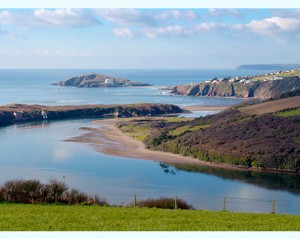
A view of the harbor at Aveton-Gifford in Devon, a possible ancestral homeland?

During the anticipated long wait for SNP results, I will attempt to sort through how the y-DNA data on “close relatives” meshes with my genealogical research based on birth records, wills and other paper trails, as well as my speculative guesses based on historical events in England and Virginia – ideas that have been set forth on these website pages.

I’ve been doing some initial work on who is I-M253 in my y-dna line and also in other male lines known to have intermarried at some point with the male ancestors who are directly in my y-dna line.

I’m aware that this is a departure from the traditional ways of doing genalogical research with the construction of family trees based on records that rise to the level of acceptable genealogical proof. Readers of this website know I like all of the records – wills, census documents, Quaker meeting minutes, historical maps, photographs if available.

But how can tracing y-dna lines help with genealogical research? I believe that there are special situations in “deep ancestral research” that make what seems impossible to prove not to be. These special situations include historical reasons why particular groups intermarried, and why groups of families retained relationships with each other over centuries.

Note that the name of the website refers to “Vikings” and to “Virginians”.  Why so?

It’s a known fact that the Viking aristocracy that took over England after the Battle of Hastings kept power in the Norman-descended families for centuries, while families continually were intermarrying.

There are some particular subgroups that appear to be relevant to my family history. These include religious dissenters (Protestants in Catholic England, Quakers and Baptists in Anglican Virginia).

Also, the particular surnames, that range from not partiularly common to quite rare are all represented in the coastal counties of Southern England, particularly England’s Southwest –  Devonshire, Gloucestershire, Dorset, Wiltshire. The surnames often show up with maritime activities and/or with religious dissent.

Significantly, in the revolutionary 17th century decades leading up to and through the English Civil War and continuing through the Restoration, many persons so surnamed, or associated with lines genealogically related, had access to ships engaged in transatlantic voyages.

Although none of this is yet proof, none of it seems to me to be inconsistent with my “descendants of Norman aristocracy” hypothesis, nor my idea that, at least some members of my ancestral families, had the wealth and expertise to be engaged in maritime activities, and/or had access to ships bound for the New World.

More will follow!


Posted in DNA STUDIES | Comments Off on Sorting through the Y-DNA clues

A DNA Expert’s Response to my 111-marker DNA results

Continue reading

Posted in DNA STUDIES | Comments Off on A DNA Expert’s Response to my 111-marker DNA results

Searching for Kerley Roots in Dorset and Southern England, part 3.

What do we know of the Kerleys of Ashmore in the period 1638 through 1642? 1642 was an important date, because the Protestant Returns of 1642 were promulgated and the records for Ashmore in Dorset survive. 

For those unfamiliar with the Protestation Returns of 1642, the following is excerpted from a Wikipedia article:

“The Protestation Returns of 1642 are lists of males over the age of eighteen who took, or did not take, an oath ‘to live and die for the true Protestant religion, the liberties and rights of subjects and the privilege of Parliaments’. These lists were usually compiled by parish, or township, within hundred, or wapentake. They are of importance to local historians for estimating populations, to genealogists trying to find an ancestor immediately before the English Civil War and for scholars interested in surname distributions.[1]

Background

In May 1641 reacting to scares, rumours of plots and anxiety that the Protestant reformation was in danger of being undone, a ten man committee of the House of Commons, in the Long Parliament, was appointed to draft a national declaration.[2] It was the first of three oaths of loyalty imposed by the Long Parliament, between May 1641 and September 1643. The others were the Vow and covenant and the Solemn League and Covenant[3]

“The declaration, or Protestation, read:

I, _ A.B. _ do, in the presence of Almighty God, promise, vow, and protest to maintain, and defend as far as lawfully I may, with my Life, Power and Estate, the true Reformed Protestant religion, expressed in the Doctrine of the Church of England, against all Popery and Popish Innovations, within this Realm, contrary to the same Doctrine, and according to the duty of my Allegiance, His Majesties Royal Person, Honour and Estate, as also the Power and Privileges of Parliament, the lawful Rights and Liberties of the Subjects, and any person that maketh this Protestation, in whatsoever he shall do in the lawful Pursuance of the same: and to my power, and as far as lawfully I may, I will appose and by all good Ways and Means endeavour to bring to condign Punishment all such as shall, either by Force, Practice, Councels, Plots, Conspiracies, or otherwise, doe any thing to the contrary of any thing in this present Protestation contained: and further, that I shall, in all just and honourable ways, endeavour to preserve the Union and Peace betwixt the Three Kingdoms of England, Scotland and Ireland: and neither for Hope, Fear, nor other Respect, shell relinquish this Promise, Vow and Protestation.[4]

“It was taken by the members of the House of Commons on 3 May 1641. The following day the Protestant peers in the House of Lords also swore it. Subsequently on the 18 January 1642, perhaps prompted by the King’s attempt on the 4 January to arrest the Five Members of parliament, the Speaker, William Lenthall, sent out a letter to the effect that that all males of eighteen or over should take the oath.[5] The idea was that those that refused to take the oath would be presumed to be Catholics and so unfit to hold office in Church or state. In fact it was not a particularly effective way of distinguishing Catholics from Protestants, as in some areas Catholics took the oath with reservations concerning their religion, and others that were known from recusancy lists, appeared on the returns.[6

The Protestation Return, 1642 for Ashmore had 37 signators of who the following were listed: Watson, Ashmore. p. 129

William Kerley; Rich. Kerley

(signed Thos Dibbern and Will. Kerley, Churchwar.)

Wikipedia definition: A churchwarden is a lay official in a parish church or congregation of the Anglican Communion, usually working as a part-time volunteer. Holders of these positions are ex officio members of the parish board, usually called a vestryparish councilparochial church council, or in the case of a Cathedral parish the chapter.

 ___________________

The references to the lists of the Ashmore parishioners taking the Oath of Protestation and to the lists of residents of Ashmore seen below are from the work of  E. W. Watson, M.A. entitled Ashmore Co. Dorset A History of the Parish With Index to the Registers 1651 to 1820, Society of St Andrews, Salisbury, Wilstshire, 1890. Each reference to that work is listed as “Watson, Ashmore.”

1291

Here are earlier “Lists of Residents” of the Ashmore Parish, see Watson, Ashmore, p. 129.

Iniquistio Honarum, 1291: Subsidy Rolls 2 Ed. iii: Will. le Carle (WHB- 1 of 15 persons listed)

________________________

1563

Note from Watson, Ashmore, p. 129

“The names for the Hundred of Cranborne  are given together, without distinction of parish in tis Roll. The only names which appear to belong to Ashmore are:

5 Eliz. [WHB-1563]  Will. Kirley (one of 5 persons identified by Watson)

_____________

1621

Note from Watson, Ashmore p. 130

“Witnesses to Livery of seisin: –

1621 William Kerley (was one of seven persons listed by Watson)

1635 William Kerley, senior; William Kerley, junior 

Wikipedia Note: Livery of seisin is an archaic legal conveyancing ceremony, formerly practiced in feudal England and in other countries following English common law, used to convey holdings in property. The term “livery” is related to, if not synonymous with, the word “delivery” as used in modern contract law. The common law in those jurisdictions once provided that a valid conveyance of a feudal tenure in land required the physical transfer by the transferor to the transferee, in the presence of witnesses, of a piece of the ground itself, in the literal sense of a hand-to-hand passing of an amount of soil, a twig, key, or other symbol.

___________________

1638

The following excerpts are from Sumner Chilton Powell’s Puritan Village: The Formation of a New England Town, p.72

“In 1636. William Kerley, or Ashmore, Dorset, a parish just next to Donhead St Mary, was cited at the archdeacon’s court for ‘neglecting his parish church.’ Kerley simply replied, ‘that he did not do this out of contempt, but in respect that he has land at lower Donhead and has something to do there.’ He was dismissed with a mild warning to improve his habits.

(Powell’s description of William Kerley’s encounters with the Anglican church and his settling in the Puritan village of Sudbury, Massachusetts, and the later Kerley Oaths of Protestation suggests that the Kerley family’s religious orientation was Puritan.)

_____________

Index of Parishes Mentioned in the Ashmore Parish Registers”

Charlton (not specified, almost certainly the Chapelry in Donhead S. Mary) Kerley I.


Posted in KERLEY | Comments Off on Searching for Kerley Roots in Dorset and Southern England, part 3.

Searching for Kerley Roots in Dorset and Southern England, Part 2

 In my discussions in “Searching for Kerley Roots in Dorset and Southern England, Part 1”, I revisited an earlier post on the 1642 passage of a Richard Kerley to Virginia, sponsored by Hugh Gwyn.

I would also like, in this part of my speculations, to revisit a post entitled Notes on the Kerley and Saunders Family Immigration to the American Colonies, Part 1 that I made on June 3, 2013, in which I stated the following:

“The history of the 17th century settlement of the English colonies suggests that researchers should be looking both in England and the Colonies for relevant genealogical information. However, I suspect that researchers in Virginia and Massachusetts tend to discount the possibility of finding genealogical clues in the “other colony”.

“But it might be worth some consideration. Take a look at the following information on the passengers aboard a 1638 voyage of the Confidence, bound for settlements in Marlborough and Sudbury, Massachusetts:

 ~ THE CONFIDENCE ~Marlborough Settlers
 “CONFIDENCE, of London, two hundred tons, John Gibson, Master. She sailed from Southampton the last of April,` by vertue of the Lord Treasurers warrant of the 11th of April,1638. 1

“JOHN SANDERS,  25 of Langford, Wilts, Salisbury, husbandman; Mrs. Sarah Sanders, John Cole 40,  Roger Eastman 15 servant; Richard Blake                                                    16 servant; William Cottle 12 servant; Robert King 24 servant . . .                                                      

“[WHB: Note the following passengers on that voyage of the Confidence:]

“EDMUND KERLEY 22 of Ashmore, county Dorset;  husbandman                                                                                 William Kerley husbandman Sudbury; Edmund Morris                                                     of Kington Magna, county Dorset.”

Some Hypotheses:

1) If, indeed, the Hugh Gwyn of 1742 is the Gloucester County (Virginia) landowner Hugh Gwynne, who was later a member of the Virginia House of Burgesses, it would be almost certain that Hugh Gwyn was a member of the British gentry.

2) That Edmund Kerley (Ashmore)  and William Kerley (Sudbury), the three 1638 passengers on the Confidence and Richard Kerley, the 1642 passenger sponsored by Hugh Gwyn, are somehow related, and that the decisions of each of them to leave England for the American colonies were not coincidental.

The following discussion from the website www.living-in-the-past.com about the 17th century British term “husbandman” used to describe William and Edmund Kerley should be considered:

“The debate about what the term “husbandman” means in the 16th and 17th centuries is by far yet unresolved. Some sources suggest it merely means “a farmer, or anyone occupied in agricultural pursuits.” Another source indicates it could be used merely to mean “householder, or head of a family.” One can see Richard using it this way to identify himself as the head of the household he was about to describe.

“But there is also a body of data suggesting the term “husbandman” applies to a very specific rank or class; being lower than yeoman and higher than labourer. And this brings us immediately to consider the use of the term”yeoman” in the Parish records. Again, there is much disagreement about the exact meaning or meanings of the term “yeoman”. Generally the term derives from the former “free tenant” or “freeman of the Manor” in feudal society. It was clearly used to describe rank and status in rural society by the latter half of the 15th century, and by the 16th century it had come to mean a man holding free land to a certain value.

“But even that is debatable, for some farmers who merely rented their lands and owned little or none of their own were often recorded as”yeoman”. In records pertaining to legal matters in the time of James I, the term “yeoman” was sometimes crossed out and changed to”husbandman” when it was found the man had no freehold property, and in another instance “husbandman” was changed to “yeoman”when it was shown he did have such property. And statements like that below strongly suggest a clear heirarchy separating the two.

“The honourable will abhor them; the worshipful will reject them; the yeoman will sharply taunt them; the husbandman will utterly defy them;  the labouring man bluntly chide them.”  1567

“In the most general terms, “yeomen” were part of the rural agricultural heirarchy in Elizabethan times. At the top of the scale were the”gentry”; below them the “yeomen”, below them the “husbandmen” and, at the bottom of the scale, the “laborer” who worked only for wages and owned no land. At minimum, “yeomen” may be defined as “independent landowners living on their own property.”

If further research appears to strengthen the two hypotheses presented above, a corollary might also be considered:

That Hugh Gwyn and his close relatives were regarded as being of a higher social status than William, Edmund or Richard Kerley.

There are documents from Dorset, including some from a later time, that might be offered for further speculation, which I will do in the next part of this essay.

Posted in KERLEY | Comments Off on Searching for Kerley Roots in Dorset and Southern England, Part 2

Searching for Kerley Roots in Dorset and Southern England, Part 1

I’m waiting for the ftdna.com to complete my 111-marker y-dna test results. (All values are in except for markers 38 through 67. When those are in, I’ll have more to say on this subject.)

In the meantime, I want to spend to some time on England’s County of Dorset, particularly the seacoast town of Bournemouth.

Why Bournemouth?

One of my family history theses has been pieces of evidence suggesting that several of my ancestral lines – going back centuries – were involved with ships and the sea.

I’ve been prompted by Edie Kearley, who is very much involved in a “Surname project”, this one for the names Kerley, Kearley, Curley and other similar sounding surnames. She had found me because the vikingsandvirginians.com website has included a lot of seemingly random entries about the name Kerley.

Let me review why the Kerley name appears on these pages. When I took the ancestry.com y-dna test, a person surnamed Kerley (with whom, so far, I have been unable to establish contact) has y-DNA values that are the same as mine, except for three that are only one number off.  The ancestry.com calculations suggest a Most Recent Common Ancestor within historic time.

In search of a Most Recent Common Ancestor (MRCA)

There is an advantage to descending from persons who lived in England, in French Normandie, and in the American Colonies, because so many records exist, albeit in a myriad of locations. I believe that powerful search engines such as Google can help identify data sources that would not have been considered in traditional methods of family history research.

I support the traditional methods of proving relationships with records that establish birthdates, mother and father, place of birth, siblings and supplementary information for each individual in a family tree. But one needs clues to know where to look for such documentary evidence.

Finding a MRCA in Historic Time

I believe that traditional genealogy can be supplemented with other methods that use DNA results to help decide where to look for clues.

Sorting Through Clues I Already Have (Part One)

In my 5-11-13 vikingsandvirginians.com post entitled  17th Century Saunders, Crump and Kerley Immigrants to Virginia I made note of the following passage to Virginia from England:

“1642 Richard Kerley, sponsored by Hugh Gwyn (unknown)

[WHB – in 1642, Hugh Gwyn also sponsored John Averry (unknown).]”

The following information is  from History of the Gwin Family by Jesse Blaine Gwin pub. 1961

pg. 12 VIRGINIA Col. Hugh Gwynne was an early settler in Gloucester County, Virginia and was a member of the Virginia House of Burgess in Jamestown, 1652-1690. Some of the Descendants of Hugh Gwynne changed their name to Gwin, Gwinn or Gwyn.

Col. Hugh Gwynne was very prominent in the early Colonial Days and was closely associated with the Washington’s, the Reades, the Randolphs, the Carters and other leaders of that time.

The name Hugh Gwynne (Gwyn, Gwin) occurs frequently in the Colonial records. He is known to have owned, in addition to Gwynne Island. 6000 acres on the Potomac in Westmoreland County and 700 acres in Isle of Wight County. Not much is known about Col. Hugh Gwynne’s family as Gloucester County records were destroyed but Media Research gives his children as Elizabeth, Hugh, and Rev. John. Rev. John came over in Cromwell’s time and was pastor of Abington and Ware Parishes. He is recorded as the father of Edmund Gwin who married Lucy Bernard. They were the parents of Lucy and John Gwin.

There may have been earlier arrivals of Gwins in America, but if so none of them represent permanent settlers . It is recorded in Americans of Gentle Birth that Capt. Peter Wynne, of the Kings Council, came over with Capt. Newport on the ship Mary and Margaret. It should be repeated here that the Gwyns and Wynns are from the same family in the Old World. . . . 

WHB: Neither Gwyn and Kerley are common surnames, so establishing a linkage between Hugh Gwyn and Richard Kerley in the mid-17th century is a useful place to start some additional research. There is ample evidence that a Hugh Gwyn was an early landowner in Tidewater Virginia (on the peninsula in which Gloucester County, VA is located).

There are Gwyns and Richard Kerleys throughout the 17th and 18th centuries in Dorset. A century after Hugh Gwyn sponsored Richard Kerley’s passage to England, another Richard Kerley is identified with the seaboard community of Bournemouth in Dorset, and two small communities nearby.

One must always keep in mind that all the early and mid-17th century England was a time of religious struggles that led to the English Civil War, and in 1649, the beheading of King Charles I and the creation of the Puritan Commonwealth.

Any journeys between England and the American colonies should be considered in the context of the polticial situation and the relation of powerful persons to the English sovereign (whether king of Commonwealth Protector) or to such persons with power.

If John Gwyn was both a Virginia landowner from the 1620s and a sponsor of immigrants to Virginia, Gwyn’s relationship to the crown and Kerley’s relationship to Gwyn is worth considering.

That might be one of the subjects considered in Part 2 of this discussion.

Posted in KERLEY | Comments Off on Searching for Kerley Roots in Dorset and Southern England, Part 1

English Surnames and Viking Names: Some Initial Correspondence

Naming a Most Recent Common Ancestor:

My cousin Anthony Crump whose y-DNA values show that we share a Recent Common Ancestor, and who has decided, like myself and my correspondent from Ottawa, to take an 111 marker y-DNA test. The following correspondence addresses what very well may be a useful area for research. If we know we have a Common Rscent Ancestor, what might be that Ancestor’s surname?

Below is Anthony’s correspondence and his question

” . . .  I will have the 111 maker test run also and when I get the results back I will send them to you.

“Our current [surnames] might be temporary.  Since we go back to the Vikings, what was our Viking name?  The Vikings ruled from 800 – 1100 AD.  However our Viking ancestry could have been earlier.  There must have been people prior to the Vikings that were pre-Vikings.

In other words the Viking that ruled from 800 – 1100 AD had ancestors.  At what point in history did our line of Viking blood enter into England where the origin of the sir name Crump was taken over?  What Viking did the deed?  Who was he?  I found on Y-search DNA from the area and with the I1 Viking gene that is somewhat of a match to ours.  Maybe you can look into that a little more with the info I sent you.

Your web site is growing all the time and is discovering and exploring new findings using DNA results and comparisons to break through the limitations of the paper trail.  From Vikings to Virginians is an excellent web page for those who study ancestor research.

The finding of the Viking gene was a big step forward.  Then studying of the Viking history was another research that unlocks the movement of the Vikings and the who, what, when, where and why they invaded other countries.  All this played an important role in our ancestry past and the development of who we are today. Very interesting and entertaining.

Maybe this explains some of my behavior issues in my youth when I had a great appetite for women and sometimes loud outbursts of anger due to my uncontrollable temper when things did not go my way. All maybe associated with my Viking blood.

“Thanks again, Tony (Anthony Dwight Crump)

My response to Anthony Dwight Crump:

Hi Tony –

My current hypothesis is that at least some of my ancestors (including maternal lines) were French Normans who came over from France (Normandie) around or just after the time of the Norman Invasion in 1066 a.d.

I’m hoping that my 111 marker data will yield some insights into my exact relationship with a French Canadian correspondent, who himself descends from the Norman Vikings.

Recall that between William the Conqueror and Edward I many of the Norman rulers of England had property in both England and France. It was only with the Hundred Years War that our ancestors had to choose whether they were English or French.

Your question about surnames is a good one. Right now, we have no idea. However, I probably would go with the assumption that the Norse tradition of naming sons for their fathers (e.g., Arne Olafson) continued for many centuries. It wasn’t until the 14th century (or later) that an Englishman was expected to have a surname.

Therefore, it is quite possible that some of these related English surnames (Saunders, Kerley, Crump, to which I would add Vassar and Ayres) relate to land possessions in France or England eight or nine centuries ago, or places that branches of the family resided in the 1300s.

Let’s keep in touch on the 111 markers.

Cordially, Bill

Posted in DNA STUDIES | Comments Off on English Surnames and Viking Names: Some Initial Correspondence

My welcome to y-DNA Haplogroup I-M253

Note: I am currently completing the process of transferring my y-DNA 46 marker results form ancestry.com to ftdna.com. On the basis of what ftdna.com has have received so far (my DNA test kit that I returned to them and the marker values from ancestry.com), I have been identified by ftdna.com as being in Haplogroup I-M253.

In researching this specific haplogroup entity, I sent an e-mail to Mr William Hartley, who is identified as the I-M253 Haplogroup Project Leader.

I’m sharing the following e-mail correspondence with my vikingsandvirginians.com readership:

E-mail correspondence to Mr William Hartley, I-M253 Haplogroup Project:

Hi William –

I have recently transferred my 46-marker Y DNA test results from ancestry.com to FTDNA and they placed me in the I-M253 haplogroup.

I will be ordering the 111 marker test from them, and will be most interested in following your I-M253 project.

Cordially, Bill

E-mail correspondence from Mr William Hartley, I-M253 Haplogroup Project:

Hello William, good to hear you’ve joined our I1-M253 Project.

I see one Y-37 Burnett listed who is from Ohio, I1-M253 [Generic] no known ancestral origin but he has matches to the Creasy family, do you have that surname in your research?

Once your STR markers show up I’ll take a look, see if you match this gentleman, and see if I can better place you both.

Burnett Name Meaning – Scottish and English: descriptive nickname from Old French burnete, a diminutive of brun ‘brown’ (see Brown).

The surname is more commonly found in the North of England and Aberdeenshire, as you likely know.

The Y-111 will very likely tell us a lot more than Y-46. Once that result comes through I’ll look again.

E-mail correspondence to Mr William Hartley, I-M253 Haplogroup Project:

Hi William –

I do have genealogical information to supplement your I-M253 entry surnamed “Burnett”. I have discussed this at considerable length on the website vikingsandvirginians.com.

In fact, early in the first decade of the 19th century in Bedford County, Virginia, three “out of wedlock” sons were born to Priscilla Carter Burnett, the apparently estranged (but not divorced) wife of Williamson Burnett, a Bedford County slaveowner.

The father of Priscilla’s three boys was either Julius Saunders or a male relative who shared his genetic line. All three boys fathered sons and the male descendents of all three boys are numerous. I have direct knowledge of men from each of the three lines who have taken y-DNA tests that have confirmed this information.

My own male ancestral lines include men who lived close to and likely married into the Creasy family. (I have discussed this on my website.)

All of the families descended from these three sons of Priscilla Carter Burnett were members of two “anti-establishment” religious sects, the Quakers and the Baptists, who in the early 19th century were both anti-slavery.

Many of those Quaker and Baptist families left Virginia for Ohio (a free state), those who stayed behind were in anti-slavery counties of Western Virginia, a big chunk of which joined with the Union during the Civil War and became the state of West Virginia.

All of this information suggests that the Burnett with Creasy relationships living in Ohio is with almost absolute certainty descended from one of the three Burnett sons – William(son), Joseph and Christopher Ammon, whose mother was Priscilla Carter (Burnett) and whose father is Julius Saunders of Bedford County, Virginia or a brother Saunders.

Saunders and Creasy are prominent names in the Southern part of Bedford County, Virginia (itself in the Western part of Virginia).

You may wish to share this information with the Ohio Burnett you include in your study. Interestingly, most Saunders in the Sanders/Saunders DNA surname project are not I-M 253, but a couple are. I can see another line of inquiry to be pursued thee.

Cordially, William Burnett

I have further e-mail correspondence to share, but will first follow through on the processes required to order the 111 marker DNA test.

For those wishing to correspond with me directly on this matter, please use [email protected].


Posted in DNA STUDIES | Comments Off on My welcome to y-DNA Haplogroup I-M253

An account of my Y-DNA Testing Strategy to Increase my Markers to 111

Note from William:

The current turmoil created by Ancestry.com’s decision to no longer conduct or support y-DNA testing has led to considerable confusion.

For myself and others whose previous y-DNA tests have indicated that we share a Recent Common Ancestor in our male lineage, and who have wished to pursue additional y-DNA testing, it appeared to be a difficult problem in determining what course of action to pursue.

Therefore, I was pleased that my correspondent from Ottawa compared the y-DNA  I posted previously on this site, for members of the Burnett (descended from Saunders), Kerley and Crump families, with his own y-DNA values and determined a probable relationship, for which additional research is warranted.

I subsequently provided him with all the y-DNA values that from my own test. After his comparison, he provided me with the following suggestions as how to proceed.

“For the DNA test, only one male need to be tested as the paternal Y-DNA ancestral markers got passed down from father to son, son and so on. So all male Burnetts [note from William-that is, Bedford County, Virginia Burnetts determined to be descended from a person surnamed Saunders]  have it.

“One can be tested and all relatives share the costs & results. If you decide to do it, increase your ancestral markers to 111 (FTDNA US$ 389 full testing but if they accept what has been at Ancestry.com for a small charge, then increase from 67 to 111) and include these two tests one called SNP Backbone panel test to confirm that you are in HP I, and the second the SNP subclade to confirm that you are in HP I 1 or HP I 2.

“I do not know the cost at FTDNA for these SNP tests but I would think under US$100. This subclade HP I1 has 6 further sub-groups not all yet defined as 4 studies are underway in 4 Scandinavian countries ( Sweden, Denmark, Finland and Norway).

“These studies are being done by FamilyTreeDNA and Genebase. I checked my markers against the 6 sub-group and mine don’t fit in any of them. So my HP I1*. The star indicate undetermined. To be part of HP I, you have to test positive at two SNP Location subclade M258 (mutation from T>C), and M253 (mutation C>T) or to have DYS455=8, DYS462=12 which you have. To be in HP I1-uN (which is Ultra-Norse mostly Norwigian & Icelandic people), you need to have DYS511=9.

“There is a possibility that FTDNA may be ahead of Genebase and may offer sub-subclade tests. I am saying this because FTDNA test for 111 ancestral markers whereas Genebase offer test for only 91 markers and none for sub-subclade 1*

“Now that I have group[ed] together all our markers, we have 14 genetic distance because we have 14 markers that are different. Check the spreadsheet. This mean that your family origin into Ireland, Scotland, England, and British Isles may have taken place in 4 different ways: 1) First raid by the Vikings from Scandinavia (Norwigian or Danes) in the 5th or 6th centuries, 2) The Viking (Norwigian) invasion that started from year 841, 3) Norman Vikings that conquered and settled in England in year 1066, 4) immigration from France or Norway in the 16th century.

“M___ G___”

William’s Thoughts on Opinion of Ottawa Correspondent

Those of us who are descended from Virginia families that arrived in the colony in the 17th century, from my knowledge of English and of Virginia history, are very likely descended from – either through our paternal or maternal lines – from Norsemen in one of the first three groups that the Ottawa Correspondent identifies: first raids of 5th/6th century, Norwegian raids 9th century, or Norman invasion of 11th century.

Historically, the settlement of Virginia is most likely comprised in the majority by the Norman invasion. This group dominated the ruling class in England from the 11th century through the 16th, and through much of the 17th.

I think it is iless likely that there is a historical case of Norwegians or French Normans arriving in England in the 16th century, who then migrated to Virginia.

We’ll see what the more extensive DNA testing shows (or suggests).

Follow-up activities by William on FTDNA test:

Subsequently, I contacted Family Tree DNA and determined that they had a process (for a modest fee) where the values from my Ancestry.com y-DNA test can be entered into their data base. I’ve paid for that service, as part of a larger plan to obtain the 111 marker test.

Receipt of DNA Testing Kit:

Only a couple of days after I had ordered the Family Tree DNA, the kit arrived. I did the cheek swabs and mailed the swabs as instructed back to Family Tree DNA on Saturday, July 12th.

Follow-up with FTDNA Testing Kit Results and Ancestry.com Data Transfer

Because the Ancestry.com y-dna test was a 46-marker test and I have been advised to take the 111-marker test, I thought it would be useful to let others know how FTDNA follows through.

First, an electronic form was provided me to enter the Ancestry.com values (with the warning not to make any mistakes). These transfer values were accepted by FTDNA.

Second, I had to provide proof that these were the actual values recorded by Ancestry.com.  Downloarding the Ancestry.com results from their website (displaying Ancestry.com’s logo) as a .jpg met this requirement.

Third, a few days later, the swabs produced three rows of my initial results (totalling 37 markers) which are accessible to me on the FTDNA website under my Kit #. Interestingly, their results differed from Ancestry.com’s results, especially on DYS442, which equalled 12 on FTDNA and 17 (a value apparently unprecedented in all human y-DNA research) on Ancestry. FTDNA appears to have substituted their own calculated DYS442 value into their table of the “transferred” values from Ancestry.com.

[Without knowledge of how Ancestry.com calculated the DYS442 value, I am tentatively guessing that at some point in the process, somone recorded the number “12” for that value in handwritten form, and then that person or another person misread the “2” and recorded a “7” instead. Since Ancestry appears to be getting out of the y-DNA testing totally, I may never know.]

Subsequently, I’ve ordered the 111-marker test. Because I transferred data from Ancestry, there is a (rather substantial) discount. However, to obtain the discount, I used their 800 number rather than their website, since their website seems not to be programmed to calculate the discount as part of the 111-marker fee.

For others interested in this process, feel free to contact me at [email protected]


Posted in DNA STUDIES | Comments Off on An account of my Y-DNA Testing Strategy to Increase my Markers to 111

Some “Points of Introductory Conjecture” about 18th Century Persons Named Julius Saunders

The following correspondence from a relative in Houston has prompted me to pull together some thoughts about Julius Saunders of Bedford County, Virginia. Please contact me at [email protected] if you have information to clarify any of the issues raised here.

William,

Been reading your commentary on the two Julius Saunders. I was recently made aware of a third, b 1755 in Virginia and in Kentucky for Revolutionary service. Have you come across him before?

A DNA test is forthcoming for one of my siblings. We are descended from George Woodward Saunders b 1819 in Kentucky. His probable father was John G, whose probable father appears to be the Julius b 1758.

P. S.
Houston, Texas

Hi P____ –

The DAR record contains only a fact or two, the name, the death in 1799, and the defense of Fort Logan.

However, this information in itself does not appear to me to be based on any document.

I did come across a muster roll of Captain Ben Logan’s militia.

Logan’s Fort Kentucky prior to Boonsboro battle in 1778 The Militia of 1777… The following is recorded exactly from the Draper Papers: A list of Capt. Ben LOGAN’S pay roll with oral note* – gives among others, v ig. Capt. Ben Logan Lt. John Logan Alex Montgomery, Ensign* Azariah Davis, Ensign Benj. Patton, Sargt. Wm. Menifee, Sargt. Rosel Stevens, Sargt. George Clark, Sargt. Hugh Leeper John Martin James Leeper George White John Fain Wm. Casey Robert Barnett John Kennedy JULIUS SAUNDERS, Benjn. Briggs Nich. Proctor, Sr. Nich. Proctor, Jr. Page Proctor Joseph Proctor Reuben Proctor Philip Trammel Geo. Scote Joseph Kennedy Jared Menifee James Menifee Wm. Whitley *This roll must have been made out prior to Sept. 1778 when, Alex Montgomery, Ensign, was killed on Kenton’s horse foray.

I don’t want to reject a lead out of hand, but would be very interested if you or anyone else has knowledge of what happened at Fort Logan, whether the person named Julius Saunders was the JULIUS SAUNDERS from the Fluvanna portion of Albemarle County. He would have been 20 if you use my guess of 1758 birth or 23 if he were born in 1755.

If we do a little more digging about this muster roll, and Ensign Montgomery and Kenton’s horse foray, maybe those will tie it to Albemarle.

Cordially, Bill

 I like your term “points of introductory conjecture” and decided that our e-mail exchange should be posted on the vikingsandvirginians.com site. I can always edit and revise if (1) we get new information to supplement what we have discussed so far, (2) if you prefer not to have your name associated with the web-post. . .

Several of our family history-oriented relatives do read the website, and may have some leads. In the meantime, I’ve begun to dig up bits about the Logan et al., especially the controversies surrounding Daniel Boone. I suspect our ancestors knew a lot of these players.

Cordially, Bill

Bill,

Thank you for your reply and the Logan’s Fort information.

The DAR record was of interest to me because there are three Virginia-born Julius Saunders indexed in their roll, with two appearing to have served in different states with different years of birth, though being recorded as 1755 (A100552) and 1758 (A100553) – with Julius the husband of Jemima (A208813) being the third. Curious that A100553, or the “Captain” as he’s referred to in your writings, has been earmarked for further review. Given your attention to detail, it’s presumed that there is more information on his service to establish his rank and service record. Would love to have that info if you have it handy.

I know this means next to nothing other than as an early exercise. Thought you might find it interesting with your hypothesis of Julius being the son of Julius and not of George. If there indeed were two Julius Saunders of the same 1750s generation, it occurred to me that the elder Julius could yet claim one as a son without disqualifying the other as the son of George.

We’ve been aware of the potential parentage beyond George Woodward Saunders b 1819 of Kentucky, though we’ve not even penciled it in over the years because of a lack of direct documentation, and that research efforts have gone elsewhere in the tree. His first son James Wood Saunders* is my second great grandfather. His fifth son Wesley Zachary Saunders was a documented DAR descendent for this member 537158, linking him to Julius A100553.

Again, our documents run a little thin beyond George Woodward. He is noted as Woodward G. Saunders (inconsistent with the George Woodward from Census, land, and church records) on p 546 of Biographical Review of Cass, Schuyler, and Brown Counties, Illinois, 1892.** His father is listed there as George W. instead of the John Gardiner of New Kent, Virginia, which has presented a wrinkle.

Other families’ online research appear to link George W., John G. and a Julius as the sons of Julius and Jane Hughes Saunders with various birth dates (and of course, no direct sources listed): ex. http://records.ancestry.com/jane_hughes_records.ashx?pid=25209794.

At this point I don’t know how much use this would be on the website beyond points of introductory conjecture. My next stop is to review an alleged large Saunders file in the Clayton Library here in Houston as the former work of a Katherine Reynolds. Of course we’ll also pass on any future DNA findings or points of interest.

Regards, P_____ from Houston

Several of our family history-oriented relatives do read the website, and may have some leads. In the meantime, I’ve begun to dig up bits about the Logan et al., especially the controversies surrounding Daniel Boone. I suspect our ancestors knew a lot of these players.

Cordially, Bill

In the meantime, here are a few issues about Julius Saunders that I feel should be advanced as “points of introducctory conjecture”:

1. Did, in fact, the JULIUS SAUNDERS, whom I believe was born in January, 1758 in what is now Fluvanna Countuy, Virginia (then Albemarle) participate in the Revolutionary War activities on the Western frontier (Kentucky)? He would have been 20 at the time of the muster referenced above.

2. I believe that there is a strong possibility that the grandfather of JOSEPH, Ammon and William BURNETT, sons of PRISCILLA CARTER BURNETT, was JULIUS SAUNDERS SR (father of JULIUS SAUNDERS of Bedford County, Virginia, who apprenticed PRISCILLA’s three boys.

3. My current thinking is that it less probable that JULIUS SAUNDERS of Bedford County, to whom the three BURNETT boys were apprenticed, was their father. My return to Bedford County in October 2013 to do some more research there is what has changed my mind. Absent any evidence of a separation between JULIUS and his wife JANE HUGHES SAUNDERS, who appears to have lived with him throughout this period, and the close association of this family with the Bedford County Quaker Community, it seems to me improbable that JULIUS’ wife and the Quaker Community would have permitted two married persons to conduct an ongoing extra-marital affair that produced three boys.

4. The Bedford County court in a very unusual move at a time when “home correction” (in that time and place, the acknowledged customary right of a husband to take matters into his own hands when a wife was known to be “straying”) to have issues a restraining order against Williamson Burnett for physically abusing PRISCILLA CARTER BURNETT.

The complaint against Williamson was brought before the courts by David Saunders.

[See Bedford County 1805 May 27 – Court Order BK:200 ‘Williamson Burnett was ordered on his own recognizance to be of good behavior towards PRISCILLA BURNETT for 12 months by complaint of Priscilla by David Saunders.”]

It is important to know why David Saunders brought this action which imposed himself in another man’s marital situation. What WAS David Saunders’ relationship to or interest in PRISCILLA CARTER BURNETT?
What facts DO we know about David Saunders?


Posted in BEDFORD COUNTY VA, CARTER, SAUNDERS | Comments Off on Some “Points of Introductory Conjecture” about 18th Century Persons Named Julius Saunders

Correspondence on the Old Norse Section of Y Haplogroup I1

Last year, having used DNA evidence to solve a 200 year old family mystery, I posted a series of speculative essays on my paternal line, that included The DNA Evidence for Norse Origins of My Paternal Lines.

Several other posts can be accessed through the category “DNA Studies”. Another researcher has brought to my attention the close fit between his DNA markers and those of the Saunders, Crump and Kerley families that I have identified in the past.


June 22, 2014

“Hi. My name is M_____ and I am from Ottawa, Canada.

“Your family and mine share a lot of similarities. My ancestor came from Rouen, France. The Vikings raided, concurred and settled in the North in France (Normandy) starting around year 841 to the middle of the 11th century. They also raided the City of Rouen. It was probably the Norwegian and Danes that settled in France. The Normans were descendants of the Vikings.

“I am confirmed in Haplogroup I and subclade 1. Also only 6 markers are different from yours. They are DYS447=23, DYS456=15, GATA-H4= 11, GATA-A10=13, DYS452=32, and DYS449=27.  My DYS385b=15.

“I also understand that FTMDNA are conducting a study in Norway. When I visited the site, I found many in the study to have HI1 in their results.

M_______”

A Map of Normandy, with Rouen upriver on the Seine


WHB Note: My Ottawa correspondent and I are in the process of comparing information, which I expect, will lead to further research.

Posted in DNA STUDIES | Comments Off on Correspondence on the Old Norse Section of Y Haplogroup I1

Bedford County VA Quakers: Selected Notes from the South River Monthly Meetings

Selections from:

Hinshaw, William Wade, Encyclopedia of American Quaker Genealogy, pp. 289-290

South River Monthly Meeting (infrequently called Bedford Monthly Meeting)

Established 1757 from Cedar Creek Monthly Meeing. Discontinued: 1847.

Counties within bounds of this Monthly Meeting: Bedford, Campbell, Albemarle, Amherst, Halifax, Pittsylvania, Henry, Franklin and Patrick.

Particular meetings: Bedford Co. (now Campbell); Old Goose Creek – Bedford Co.; Upper Goose Creek – Bedford Co; Bedford (or Lower Goose Creek) – Bedford Co.; Hills Creek, Campbell Co.; Molley’s Creek-Campbell Co.; Seneca-Campbell Co.; Halifax (or Banister)-Halifax Co.; Ivy Creek-Bedford Co.; Kirby’s (or Dan River)-Halifax Co.

“To get a clear picture of the location of South River Meeting one needs only to think of the city of Lynchburg, Campbell County, Virginia – the city built by the Quakers of South River. In 1750 the location of the city of Lynchburg was a desolate river bank in the Virginia wilderness. In 1805 it boasted of only five or six hundred citizens.

“It had several stores, a warehouse, a ferry, a newspaper and many comfortable homes, and across the James River lived a friendly tribe of Monacan Indians. The forest pressed closely to the little town but gradually it was assuming the air of established civilization. . ”

“It was into this ‘forbidden paradise’, of which no portion is more beautiful than that in which Lynchburg is built, that our South River Quakers came, unarmed, by covered wagon and ox-cart, trusting in kinds and their own unexcelled confidence to protect them from the savages. At first they came in small groups, one or two families at a time, but finally they poured in – not in a continuous stream, but in waves.

“The South River Colony of Qukers (so-called because it lay south of the James RIver) was the third group to form a settlement in what is now Campbell County. The family of Charles Lynch, the senior, was the first to enter the area now occupied by Lynchburg and its environs. He had run away from his home in Ireland, at the age of fifteen, aboad an outgoing ship to America. That was about 1720.

“To pay for his passage across the Atlandtic he was apprenticed to a wealthy Quaker planter, Captain Christopher Clarke, who lived in that part of Hanover County which was later set off as Louisa County, and who took a deep interest in the boy’s education. Charles studied law and became a good business man, acquiring large land holdings in his own name. In time (about 1733) he married Sarah Clarke, daughter of Capt. Christopher Clarke, and about 1752, removed with his family to what was later called the Chestnut Hill estate overlooking the James River, one mile below the site of Lynchburg.

“Charles Lynch (senior) never became a Quaker, although his wife, Sarahy, was an ardenet one. She had joined the Society of Friends at Green Spring, Louisa Co., becoming a member of Camp Creek.


Hinshaw, William Wade, Encyclopedia of American Quaker Genealogy, pp. 293

“The first members of the [South River] monthly meeting were old stock Quakers for the large part, of English extraction from the tidewater section of Virginia, especially Cedar Creek and Henrico Monthly Meetings. Among the first names appearing in the books are: Hendrake, Johnson, Kirby, Neal, Candler, Lynch, Terrell, Clark, Moorman, Echols, Payne, Collins, Farmer, Roberts, Womack, Calwell and Ayrs . .  .

Hinshaw, William Wade, Encyclopedia of American Quaker Genealogy, pp. 315

JOHNSON

1748, 8, 19. Benjamin d. in Bedford Col, Va. 1769, 8, 17, m in a public mtg of Frs in Camp Creek MH, Louisa Col. Va., Mary MOORMAN, dt Thomas & Rachel (see Camp Creek Register)

Ch (including those listed in Cedar Creek MM Register)

Thomas b. 1749/50m 11 (Jan), 14 (O.S. Camp Creek MM)

John b. 1751..52, 1 (Mar), 14 (O.S. Camp Creek MM)

Andrew b . 1754, 4, 7 (N. S. Camp Crek MM)

William b. 1756, 8, 12, d next day

William b. 1757 12, 22

James b. 1759, 12, 20

Rachel b. 1762 3, 26

Elizabeth b. 1764 5, 15

Mildred b. 1766, 7, 4

Christopher, b. 1769, 3, 4

Hinshaw, William Wade, Encyclopedia of American Quaker Genealogy, pp. 318

(Note by W.W.H.) In his will, probated 9-26-1769 in Bedford Col, Va., the above Benjamin Johnson named each of his ch in the order of their b (excepting the first William who died the next day); also his w, Mary. As a wd;, Mary m (mcd) 1771 John Miller for which she was dis 1771) & had three more ch by that name (Miller). . . .

Hinshaw, William Wade, Encyclopedia of American Quaker Genealogy, pp. 319.

1789, 10, 21. John, s John & Lydia (Watkins) b. 1766, __, __, m i our public mt, Rhoda MOORMAN, dt Micajah & Susanna (Chiles) b. 1769, 8, 15, Campbell Co. Va.

Ch. of John Jr. & Rhoda

Joseph b. 1791, r, 7

Micajah, b 1792, 11, 28

John, b. 1795, 1, 3

Charles b 1797, 1, 14

Polly Moorman, b. 1799, 1, 14

Lewis, b. 1801, 3, 7

James, b. 1804, __, __

Hinshaw, William Wade, Encyclopedia of American Quaker Genealogy, pp. 322.

1789, 11, 21m John rmt Rhoda Moorman.

Hinshaw, William Wade, Encyclopedia of American Quaker Genealogy, pp. 326

1813, 1, 9, John Jr. dis doing military exercise.


Abbreviations: dis (disowned), mcd (married contrary to discipline)

Posted in JOHNSON | Comments Off on Bedford County VA Quakers: Selected Notes from the South River Monthly Meetings

Ancestral Families and the Colonial Trade (1648-1670)

1651

From the periodical Gloucestershire Notes and Queries:

1321. TOBACCO GROWING IN GLOUCESTERSHIRE. The announcement recently made by the Government of their intention to permit domestic experiments to be made in tobacco culture may render the following facts interesting to Gloucestershire agriculturists. Tobacco growing in the southern and western countiesof England became so common about 1652 that the Commonwealth Parliament of that year passed an Act prohibiting the culture of the plant, and giving liberty to anyone finding it to cut it down.

This Act appears to have caused great dismay and irritation in Gloucestershire. In August, 1653, soon after the reassembling of the House of Commons, “the humble petition of some of the inhabitants of Gloucestershire concerning the planting of English tobacco ” was presented by General Desborow. who, from having been governor of Bristol, was probably well known in the district.

1652

23 July 1652, Jacob Saunders of Holland, a mariner, aged 45, deposes on behalf of John Browne for 51 hogsheads of tobacco.

1653

Richard Sanders, 28 August 1653, 1 acre near the block house in James City, James City County.

1654

George Sanders will index, administrators bond rec. Northhampton County.

Thomas Sanders, 27 May 1654, Gloucester County, land near Mattapony River.

A deposition was filed by Edward Saunders, 30 September 1661, William Evans of Bristol, mariner, that in October 1654 John Freeman of Bristol, mariner, now deceased, delivered to Edward Saunders of Caerleon, Glamorgan, chirurgeon who was then bound on a voyage to Virginia, 3 menserveants to transport with him to Virginia, and there to dispose of them for profit.

The seaport region of Newport and Caerleon in Wles

[WHB – Caerleon іs а suburban village аnd community, situated оn the River Usk іn the northern outskirts оf the city оf NewportSouth Wales.

Caerleon іs а site оf archaeological importance, being the site оf а notable Roman legionary fortress, Isca Augusta, аnd аn Iron Age hill fort [Wikipedia].

Cromwell’s troops were there in 1648.]

1655

June 6, 1655:

John Hodson and John Garratt 300 acres:

To all ye whereas ye now know you that I the said Edward Diggs Esq. do give and grant unto John Hodson and John Garratt three hundred acres of land lyeing and being in the county of New Kent and on the North East side of Mottopony River bounded as followeth (viz) from a marked red oake on the Southernmost corner of Thomas
Saunders his land with a South, South East line unto Arakeyaco Swamp, thence with Arakeyaco Samp to a line of marked trees running North West by West unto the other corner of Saunders his land being a poplar in a branch of Arakeyaco Creek thence to the place it began with his Saunders his line of marked trees. The said land being due unto the John Hodson and John Garratt by and for their transportation of six persons into this Colony so to have and the hold & yielding and paying to which payment is to be made. Dated the sixth of June 1655
Cavaliers and Pioneers, p. 310; Patent Bk. #3, p. 355

1658

Amos Saunders, 1658, involved with freight on board the ship Rainbow. Named in court case.

1661

Edward Saunders, 30 September 1661, William Evans of Bristol, mariner, a deposition that in October 1654 John Freeman of Bristol, mariner, now deceased, delivered to Edward Saunders of Caerleon, Glamorgan, chirurgeon who was then bound on a voyage to Virginia, 3 menserveants to transport with him to Virginia, and there to dispose of them for profit.

1663

Francis Sanders, 26 June 1663, master of ship Black Eagle. Inwards from Virginia.

1664

John Saunders, 1664 , testifies that he was paid for his work on board ship but does not know where the payment came from. Ship was the Rainbow.

1666

Robert Saunders, 12 August 1666, a letter mentions that the Barbadoes and Virginia fleets have passed under convoy of Captain Robert Saunders of the St. Patrick, who met 6 privateers, sank 3, sent 2 into Portsmouth, and took one of 60 guns with him.

1667

John Saunders, 4 October 1667, Howard vs. Roffey. Christopher Howard owned a farm and land in Lambeth in Surrey. During trial it is testified that the farm has now been leased to John Saunders.

[A] lengthy communication was received by the Government from Bristol, on the 7th August, 1667, doubtless emanating from persons interested in the West India islands. It states that . . . the plant was grown throughout Gloucestershire, even on the land of justices of the peace ; and that as half the profits of the land are paid to the owners for rent, their interest forbids them to destroy it ; that by the King’s order given to the- High-Sheriff of Gloucestershire, with a list of places where tobacco is growing, it was ordered to be cut down, and the names of the owners returned to the Council ; suggesting, as a remedy, a letter from the King to the Judges of Assize for Gloucestershire, ordering returns to be made, and setting fines for neglect ; and that as much tobacco is grown in the neighbouring counties, a strong prohibition be issued against its sale, and a commission given to search for and destroy it” (State Papers, Domestic, 1667, p. 366).

The Government appears to have followed the advice contained in the concluding sentence of this document. In a letter dated Bristol, 19th August in the same year, from an official underling, J. Fitzherbert, writing to Secretary Williamson, is the following : ” Met 120 horse of the King’s and Duke’s guards at Leicester, making to Winscomb in Gloucestershire, to cut down the tobacco planted there in con- tempt of the law.” (76., p. 399.)

1668

Ambrose Sanders, 20 January 1668, merchant 5 hogsheads Virginia tobacco on the ship Unity of Yarmouth.

1669

John Sanders, 10 April 1669, merchant 3 hogsheads 1,296 pounds of Virginia tobacco on ship Unity of Yarmouth.


Posted in COLONIAL TRADE, SAUNDERS | Comments Off on Ancestral Families and the Colonial Trade (1648-1670)

Ancestral Families and the Colonial Trade (1638-1647)

1638

William Saunders, 12 September 1638, licenses to sell tobacco in Ingworth & Feering, Essex. Merchant charged 70 shillings.

Feering, in Essex, England

Feering is a village in Essex, England. Situated between Colchester and Witham, Feering has close ties with its geographically conjoined neighbour, Kelvedon.

Ingworth is a village and a civil parish in the English county of Norfolk.[1] the nearest town is Aylsham which is 1.7 miles (2.7 km) south of the village.

The village is 14.3 miles (23.0 km) north

Feering, Norfolk, England

of Norwich, 7.3 miles (11.7 km) east of North Walshamand 9 miles (14 km) south-southwest of Cromer on the north Norfolk coast.

[WHB – Note that, although Norfolk and Essex are both on or near the coast in Eastern England, the two communities of Ingworth and Feering have no historical tie other than both having their tobacco concessions awarded to William Saunders.]

Joshua Saunders, 15 December 1638, licenses to sell tobacco in London. Merchant charged L10. In 1639 his license to do business was in St. Catherine’s city of London.

From Thornbury, Walter, Old and New London vol 2, 1878: (Quoted in British History Online)

“Before entering the gate of St. Katherine’s Docks, where great samples of the wealth of London await our inspection, we must first make a brief mention of the old hospital that was pulled down in 1827, to make a fresh pathway for London commerce. This hospital was originally founded in 1148 by Matilda of Boulogne, wife of the usurper Stephen, for the repose of the souls of her son Baldwin and her daughter Matilda, and for the maintenance of a master and several poor brothers and sisters.

In 1273, Eleanor, widow of Henry III., dissolved the old foundation, and refounded it, in honour of the same saint, for a master, three brethren, chaplains, three sisters, ten bedeswomen, and six poor scholars. Opposed to this renovation, Pope Urban IV., by a bull, endeavoured in vain to reinstate the expelled prior and brotherhood, who had purloined the goods and neglected their duties. And here, in the same reign, lived that great alchemist, Raymond Lully, whom Edward III. employed in the Tower to try and discover for him the secret of transmutation.

“Another great benefactress of the hospital was the brave woman, Philippa of Hainault, wife of that terror of France, Edward III. She founded a chantry and gave houses in Kent and Herts to the charity, and £10 in lands per annum for an additional chaplain.

“In after years Henry V. confirmed the annual £10 of Queen Philippa for the endowment of the chantries of St. Fabian and St. Sebastian, and his son Henry VI. was likewise a benefactor to St. Katherine’s Hospital. But the great encourager of the charity was Thomas de Bekington, afterwards Bishop of Bath and Wells, who, being master of the hospital in the year 1445, obtained a charter of privileges, to help the revenue. By this charter the precincts of the hospital were declared free from all jurisdiction, civil or ecclesiastical, except that of the Lord Chancellor. To help the funds, an annual fair was to be held on Tower Hill, to last twenty-one days from the feast of St. James. The district had a special spiritual and a temporal court.

“Henry VIII. and Katherine of Arragon founded in this place the guild or fraternity of St. Barbara, which was governed by a master and three wardens, and included in its roll Cardinal Wolsey, the Dukes of Norfolk and Buckingham, the Earls of Shrewsbury and Northumberland, and their ladies. In 1526 the king confirmed the liberties and franchise of this house, which even escaped dissolution in 1534, in compliment, it has been supposed, to Queen Anne Boleyn, whom the king had then lately married.

In the reign of Edward VI., however, all the meshes of the Reformers’ nets grew smaller. Now the small fry had all been caught, the lands of St. Katherine’s Hospital were taken possession of by the Crown. Greediness and avarice soon had their eye on the hospital; and in the reign of Elizabeth, Dr. Thomas Wylson, her secretary, becoming the master, surrendered up the charter of Henry VI., and craftily obtained a new one, which left out any mention of the liberty of the fair on Tower Hill.

St Catherines Docks, London, England

He then sold the rights of the said fair to the Corporation of London for £466 13s. 4d. He next endeavoured to secure all the hospital estates, when the parishioners of the precinct began to cry aloud to Secretary Cecil, and stopped the plunderer’s hand.”

1639

Joseph Saunders, 8 October 1639, of St. Mildreds South London, a merchant aged 39 gives testimony in a case.

St Mildred’s Church, London

The earliest record of the church of St Mildred is of its rebuilding in around 1300. This was probably paid for by Lord Trenchaunt of St. Albans, who was buried in the Church at about that time. Sir John Shadworth, Lord Mayor in 1401, who was also buried in the church, gave a parsonage house, a vestry and a churchyard.[4] A description by John Strype indicates that the medieval church was an aisled building, with a clerestory.[4] The patronage of the church belonged to the monastery of St Mary Overie until 1533, when it passed into private hands.[1]

Strype records that the church was repaired throughout in 1628, when most of the north wall, the nave arcades and the windows above them were rebuilt.[5] A major benefactor of the church during the 17th century was Sir Nicholas Crisp, a wealthy merchant and ardent supporter ofCharles I,[4] who, by 1663, owned the advowson of the church.[1] His gifts included two large silver flagons, which were still in use into the 20th century, and a five light stained glass east window depicting the Spanish ArmadaElizabeth I, the Gunpowder Plot, the plague of 1625, and portraits of himself, his wife and children. He was interred in his family vault in the church, although his heart was buried atHammersmith.[4]

St Mildred’s was destroyed in the Great Fire of London of 1666. Its silver plate, however, survived, having been taken to safety in Hackney in a hired carriage.[4] After the fire the parish of the church of St Margaret Moses, which was also destroyed but not rebuilt, was united to that of St Mildred.[4]

The boundaries of East London parishes surrounding St Mildred Poulty

1640

Joseph Saunders, 5 December 1640, another court battle involving a ship named Truelove. It was supposed to return to London but instead diverted to Holland to sell its goods.

[WHB – Note the following at http://immigrantships.net]: 

True Love, departed from London, England, and arrived in Bermuda, 10 June 1635.

Note the following about the September. 1635 voyage of the Truelove, Master John Gibbs, to Massachusetts:

“This table [see http://www.winthropsociety.com] details the roll of passengers of the Truelove, which sailed from London, mid-September, 1635, bound for New England. The ship arrived safe at Massachusetts Bay, although some of the persons listed below may not have arrived. Some may have decided not to sail. Some servants may have run away. And there usually was some loss of life among the passengers from disease and malnutrition during the passage.

“This information was transcribed in the 19th century by James Savage from records found in London, at the Augmentation Office, Rolls Court, Westminster.”]

 1645 –

“[D]uring the English Civil War . trade with the Dutch provided an increase in demand . . .  Pecquet, Cato Journal, ibid.

1646

17 April 1646, John Hayes vs. Joseph Saunders, Francis Lathbury and Matthew Saunders. Another tobacco related case.

From: Coldham, Peter Wilson, English Adventurers and Emigrants, 1609-1660: Abstracts of Examinations in the High Court of Admiralty with Reference to Colonial America.

“Francis Lathbury, book keeper to Joseph Saunders, aged 24, (of St Mildred Poultry, Lond, merchant age 25/26). (3 depositions). Joseph Saunders, to whom he was apprenticed for 8 years, was the owner of the Bonny Bess which he bought from John Thierry of London, merchant, in May or June 1636 for a voyage to Virginia, and appointed Zachary Flute to go as her Master.

“The deponent paid Thierry his account and paid the ship’s purser, Edward Searchfield, for repairs carried out on her. His then master, Joseph Saunders, received one Clarke for his passage to Virginia. After the death of Flute, William Blackler was elected Master.

“The deponent is part owner of the Truelove which carried passengers from Virginia to London in 1638 at the rate of 5 pounds or 5 pounds.10s. a head. Those who shipped goods on the Flower de Luce included his brother Arthur Lathbury of London, merchant, Edmund Saunders, ___ Penryn, ____ Bradley, Simon Hake, and Henry Ledgington. She arrived home in London before the Bonny Bess. (Vols 53 & 54).

From Coldham, ibid., p. 83-84:

Abraham Orten of St Sepulchre, London, mariner aged 60. He was employed to go as cook in the Flower de Luce to Virginia and she went in company with the Bonny Bess, both having been set out by Joseph Saunders. Soe of the goods salvaged from the latter ship were brought ashore on Chaptain Thurygood’s plantation (Vol 54).

From Coldham, ibid., p. 84.

“John White of St sepulchre, London, grocer aged 35. The tobacco brought to London in the Flower de Luce proved mostly rotten and Francisc Lathbury bought part of it. Stafford, Joseph Saunders’ agent, kept the key of the warehouse where the tobacco was stored (Vol. 54)

1647

20)  21 July 1647, Joseph Saunders vs. William Holiday. In 1638, he employed Holiday, the a resident of Rotterdam, to conduct his affairs in Holland. This included dealing in Virginia tobacco. Trying to settle account.

Posted in COLONIAL TRADE, SAUNDERS | Comments Off on Ancestral Families and the Colonial Trade (1638-1647)

Ancestral Families and the Colonial Trade (1633-1637)

1633-1637 

“Tobacco prices briefly recovered . . ” Pecquet, Cato Jorunal, ibid.

1633

Thomas Sanders, 22 May 1633, imported 200 pounds if tobacco on the ship Lyon.

[WHB -The ship Lyon was associated with several voyages to Massachusetts carrying pilgrims from England. It made several voyages between 1630 and 1632 under Captain William Peirce.]

John Saunders, 16 October 1633, Obligation signed by Leonard Calvert, Jerome Hawley, Thomas Cornwallis and John. Lord Baltimore has hired Richard Orchard to be master of the Dove for a voyage from London to Virginia. Lists what they will pay as wages for the crew per month.

[The following is from the wikipedia.com biography of Leonard Calvert]:

Portrait of Leonard Calver (by Florence MacKubin)

Leonard Calvert (1606 – June 9, 1647) was the First Proprietary Governor of Maryland.[1] He was the second son of George Calvert, 1st Baron Baltimore, (1579-1632), the first proprietary of the Province of Maryland. His elder brother Cecil, (1605-1675), who inherited the colony and the title upon the death of their father George, April 15, 1632, appointed Leonard as governor of the Colony in his absence. Leonard was obviously named after his grandfather, the father of George who was also “Leonard Calvert” of Yorkshire[2]

[The following is from mdroots.thinkport.org]:

Jerome Hawley (1590-1638)

Jerome Hawley voyaged to Maryland aboard the Ark in 1633. He was a merchant from a wealthy English family. Some of his family had already settled in Virginia. His older brother was the Governor of the English colony on Barbados.

As an investor in the Maryland colony, Jerome gave Lord Calvert some money to support the voyage of the Ark and the Dove. Jerome was a Roman Catholic like Lord Baltimore. He and his wife, Eleanor hoped their regious beliefs would be tolerated in the new colony of Maryland.

Jerome returned to England in 1635. There he and John Lewger published a booklet called A Relation of Maryland. They wrote this booklet to encourage other English families to come and settle in Maryland. The book describes how the colonists lived. It also tells about the friendship between the English and Native Americans in Maryland.

While Jerome was in England, he asked the King if he could work in the government of the Virginia colony. The King made him a councilor and treasurer of Virginia. Jerome also served inQueen Henrietta Maria’s household. He died in 1638 with many debts from his investments in English colonies.

[The following is from the wikipedia.com biography of Thomas Cornwallis]:

Thomas was probably the grandson, or possibly the second son (undocumented)[1][2][3] of Sir Charles Cornwallis of Beeston, Norfolk (d. 1629), an ambassador to Spain and brother of Elizabeth Cornwallis and Sir William Cornwallis of Brome, the direct ancestor ofCharles Cornwallis, 1st Marquess Cornwallis. Thomas was probably the son (or brother) of the author William Cornwallis.[This following is from the wikipedia.com biography of Thomas Cornwallis

As the second son, he could not hope to inherit his father’s land. The Cornwallis family were Roman Catholic Recusants and therefore George Calvert‘s project of an autonomous colony in the New World for English Catholics appealed to him. In 1634 he accompanied Leonard Calvert to what was then Virginia and became a Commissioner to the Governor. This put him in a powerful advisory position to Leonard Calvert. In 1635 Cornwallis fought the Virginian colonist William Claiborne over the jurisdiction of Kent Island, and captured it in 1638. In 1643 he defended the colony against a Native American attack.

In 1644, however, Richard Ingle sailed into Chesapeake Bay with his ship Reformation and fired on St. Mary’s City. Cornwallis’ land was occupied and many of the buildings he had constructed were destroyed. As a result of these losses and his loss of influence in the colony, Cornwallis returned to England, where he died at some point after 4 March 1675. The tomb of Cornwallis and his wife is inside St Martin’s Church East Horsley.]

1634

Thomas Sanders, 19 March 1634, license to sell tobacco in Swanscombe and Cliffe, Kent.

[WHB – Note the following article from wikipedia.com which about the Danish/Viking/Norman periods of Swanscombe, which has been a location for shipping since early historic or prehistoric times.]

“From Crayford to the Isle of Thanet, the Danes occupied the land and terrorised the Saxon inhabitants, giving rise to the appearance of Deneholes, of which many have survived to this day. These were wells, cut deep into the chalk landscape, thought to be for concealing people and goods. They have a simple vertical shaft with short tunnels bearing horizontally from the base.

“The Vikings settled throughout the winter along the Thames estuary with their ships, and established camps in Kent and Essex. In surveying the distribution of the many deneholes along the Thames corridor it would appear that Essex, on the northern shore of the Thames, sustained a greater influx of Vikings than did Kent, there being considerably more recorded deneholes in Essex, particularly around Orsett and Grays – see Hangman’s Wood.

“Archaeological digs and centuries of tilling have revealed a Danish castle and settlement, with pottery, anchors, weapons and some ships’ timbers. The settlement was later variously called Suinescamp (in the Domesday Book), Sweinscamp and Swanscamp, the name deriving from the Viking king Sweyn Forkbeard, who landed in East Anglia, and became King of England in 1013. Father of Canute, Sweyn died at Gainsborough on the Trent in 1014. Canute (Cnut) died in 1035 his sons were unable to hold on to his empire, he was king of England, Scotland, Norway and Denmark.

Other research suggests that deneholes might have been dug as a method of extracting chalk for use on the fields above, or the mining may have been a by-product of defence. In any case, the practice reached a peak around the 13th – 14th centuries, long after the Viking raids had ceased.

Norman Conquest

In 1066 Swanscombe locals massed an army in defiance of William I, and so won the right to continue their ancient privileges, including the tradition of passing inheritance by gavelkind. The men of Kent met William near Swanscombe, where the Saxons concealed their number with branches, thus intimidating the Norman army. They were offered a truce that left Kent as the only region in England which William did not conquer, and leaving William known as William the Bastard (never conqueror) in this area of England alone. Kent County Council have inherited the motto Invicta, meaning unconquered.”

Medieval Cliffe, Kent (selection from a wikipedia.com post)

St Helen’s church at Cliffe was built about 1260 and was constructed in the local style of alternating layers of Kent ragstone and squared black flint. It is one of the largest parish churches in Kent, and the only dedicated to St Helen, the size of the church revealing its past importance.

Above the porch is a muniments room containing important historical documents.

“During the 14th century Cliffe was the site of a farm owned by the monks of Christ’s Church, Canterbury, when the village had a population of about 3,000.

“In the late Middle Ages the village of Cliffe supported a port, which thrived until a disastrous fire in 1520 stifled its growth, marking a period of decline, accentuated by the silting of the marshes of the Thames estuary. Nevertheless, during the 16th century, Cliffe-at-Hoo was still considered a town. However, by the middle of the 19th century the population had slumped to about 900.”

Arthur Sanders, 1634, license to sell tobacco in Salisbury, Wiltshire

[WHB – If one searches the St Edmunds Parish, Wiltshire and Wiltshire parish records for the surnames Sanders and Saunders in the late 16th and early 17th centuries, one finds the multiple entries, indicating that the Sanders/Saunders family was well established in this area.]

Witshire 1560 Richard Saunders and Alice Newman

Richard Saunders and Agnis Sutton

St Edmunds Parish 1563 Marriages: Thomas Sanders and Agnis Wheeler

Wiltshire Parish 1563 Robert Sanders and Anna Dackam

St Edmunds Parish 1565  James Spickernell and Katherine Saunders

Richard Saunders and Chrystyan Reade

Wyllyam Page and Anna Saunders

Wiltshire 1568

St Edmunds Parish 1607 John Sanders and Grace Burrowe

St Edmunds Parish 1609 Robert Sanders and Joan Rendall; Thomas Sanders and Marie Gauntlett

St Edmunds Parish 1616 Thomas Sanders and Ursula West

St Edmunds Parish 1628 Thomas Sanders and Joan Greedie

Wiltshire Parish  1638 Steven Warren and Katherine Sanders: William Perry and Alice Sanders


Samuel Sanders, 1634, license to sell tobacco in Wallingford, Berkshire

Note the following wikipedia.com entry on two prominent Saunders of Wallingford:

John Saunders (c 1589 – 29 April 1638) was an English lawyer and politician who sat in the House of Commons between 1621 and 1629.

Saunders was the son of Thomas Saunders of Woolstone in Berkshire (now Oxfordshire). He matriculated at University College, Oxford on 22 May 1601 aged 11 and was awarded BA on 28 January 1608. He was called to the bar at Middle Temple in 1616 and became Recorder of Reading, Berkshire.[1] In 1621, he was elected Member of Parliament for Reading. He was re-elected MP for Reading in 1624, 1625, 1626 and 1628 and sat until 1629 when King Charles decided to rule without parliament for eleven years.[2]

Saunders died in 1638 at the age of about 48.[1]

Saunders married Margaret Evelyn, daughter of John Evelyn of Godstone, Surrey. His son Thomas was later MP for Wallingford.[3]

Thomas Saunders (1626 – c 1670) was an English landowner and politician who sat in the House of Commons in 1660.

Saunders was the son of John Saunders of Reading, Berkshire and his wife Margaret Evelyn, daughter of John Evelyn of Godstone, Surrey. He succeeded his father in 1638 and purchased the estate of Mongewell Park, across the River Thames from Wallingford. In 1660, he was elected Member of Parliament forWallingford in a by-election to the Convention Parliament. He was commissioner for assessment for Berkshire from August 1660 and for Oxfordshire from 1661. He was J.P. for Oxfordshire from 1661, and for Wallingford and for Berkshire from 1664.[1]

Saunders died between 25 October 1669 when he made his will and 15 February 1671 when it was proved.[1]

Saunders married Anne Morris, daughter of Thomas Morris of Great Coxwell, Berkshire and had two sons and a daughter.[1]


From www.cotswold.info:

“It was during the 16th and early 17th centuries that the area around Winchcombe was extremely poor , it was during this period that a family named Tracy established themselves at Toddington, the eldest son Sir John Tracy became involved with a John Stratford who was related to him by marriage, they set up a business together to grow tobacco in the area, with plantations at Toddington and Bishops Cleeve. “Tobacco was widely grown on the Cotswolds, the Vale of Tewkesbury and in an area which extended as far south as Wiltshire.

1635

William Sanders, 1635, license to sell tobacco in Tollesbury and Salcott, Essex L4.

The Open Swimming Pool in Tollesbury, Essex

[WHB: Note that Tollesbury is a seacoast town at the mouth of the Thames River, East of London.]

From the Smugglers Britain website: www.smuggling.co.uk

Like so many of the ports and landing-points on the Blackwater, Tollesbury supports a wealth of legends about smuggling. For a long time, the nearest custom house was Maldon, and the staff there were greatly overworked, so the Tollesbury smugglers would have been free to come and go pretty much as they pleased. When the authorities became more vigilant, contraband was simply thrown overboard at one of the many creeks and inlets punctuating the estuary, to be collected when the coast was clear.

There was always a chance, of course, that goods hidden in this way would fall into the hands of ‘honest’ men, and be turned in to the authorities. In 1819 one such man, Daniel London, was dredging (probably for shellfish) and hauled up a large number of tubs of spirits that had been sunken in Old Hall Creek. He spent most of the night loading the tubs into his boat, and in the morning he sailed up to the Maldon custom house with 152 tubs. For somewhat suspect reasons, though, he overlooked 11 more, leaving them in Mill Creek, where they ‘were liable to be found by any other dredger, of which there were many near’.

When he got home a reception committee of smugglers was waiting for him, and not unnaturally wanted their property. Being reasonable men, they offered to pay him half of what the goods were worth, but Daniel foolishly declined. At this point the angry mob threatened to lynch him and his son, so the pair of them retreated indoors. When the Maldon comptroller of customs arrived, Daniel — now in fear of his life, no doubt — owned up to the other 11 tubs, and was promptly accused of smuggling and thrown into Chelmsford Gaol. In gaol, things went from bad to worse: the other prisoners assaulted him, and he eventually lost his boat, theGeorge and Anne.

The story is told [241] in letters and petitions to the customs authorities, and 170 years on it’s hard to unravel the truth. The authorities were evidently convinced that London was in league with the smugglers, and pointed out that he had a previous conviction for the offence. On the other hand, the unfortunate dredger was clearly not popular with the smugglers, either!

Old Hall Creek is now heavily silted, but at one time there were wharfs there, as rotting timbers and skeletal boats in the mud testify. When business was thriving, there was a waterside pub that had huge cellars for storage of contraband — the sea-wall hid the free-traders from view as they unloaded. The pub was long ago converted to houses as the torrent of thirsty smugglers turned — like the waters in the creek — to a trickle.

In 1779 the windows of the pub would have commanded a good view of a large cutter landing goods at one of the wharfs, and perhaps one of the drinkers was the customs officer from Tollesbury, Edward Abbot. He intercepted a labourer called William Tabor, who was carrying tea and gin which had been unloaded from the boat. Tabor tried to negotiate freedom from prosecution, but this was refused and the labourer was convicted and fined. To get his own back, Tabor accused Abbot of embezzling some of the seized goods (which the revenue man quite likely did). His attempt to discredit the officer failed, however, and when asked to appear before the local collector of customs, the smuggler lost his nerve.

Modern Tollesbury is a working waterfront. Pleasure boats are today much in evidence, but there are some working vessels too, and four beautifully restored traditional yacht stores form the centre-piece of the waterfront, reminding the visitor of the long-standing links with the sea.

Also from the website above:

Salcott-cum-Virley

TL9513 red map button , 4m E of Tiptree on minor roads

The twin villages of Salcott and Virley also feature in Melhalah: the marriage of the principal characters Mehalah and Elijah Rebow takes place in the now-ruined church at Virley. The churches are also steeped in legend associating them with non-fictional smugglers; from the church towers, signals could be flashed to Tiptree Heath, and to Beacon Hill on the other side of the Blackwater estuary. There was always a good turn-out for the service at Virley because the congregation was swelled by local smugglers who aimed to keep an eye on the contraband they had concealed in various parts of the church [236!

According to one local fable, villagers found an customs boat floating off nearby Sunken Island with a crew of corpses — all 22 men had their throats cut from ear to ear. The bodies were buried in the local graveyard, with the hull of their up-turned boat over the graves.

***

The following is from the Immigrant List of thev Merchant Bonaventure to Virginia 1635

Then follows a list of those who went to St. Domingo, after which, “These under written are to be transported to Virginea imbarqued in ye Merchant bonaventure James Ricroft Master bound thither have taken ye oath of allegeance. You will perceive an apparent repetition of the anme of Ricahrd Champion. I can only say it so so in the original.

Mary Saunders, 26, included in the above list of passengers.

1636

John Sanders, 1 April 1636, Thomas Cornwallis and John, both gentlemen, appear in the case of Orchard against Baltimore and others.

Joseph Saunders, 6 June 1636, agrees to freight the ship Flower de Luce for 8 months for a voyage to Virginia. Origin Weymouth.

1637-1645

By late 1637 a second depression [of tobacco prices] began and lasted until the mid- forties . . . Pecquet, Cato Journal, ibid.

1637

Joseph Saunders, 25 July 1637, He and William Smith undertook the freight of the Flower de Luce from Thomas Leddoze. Ship was in a very rotten state and ill fitted for the voyage which lasted from July 1, 1637 to June 22, 1637.

There are quite a few admiralty papers that list court cases that only list the last name of Saunders. In reading them they appear to be related to this Joseph and the same ship and the Bonnie Bess which went aground at Long Island, Virginia in rough weather. Two great boat loads of goods weighing 5 tons apiece were taken out of to be carried ashore but both were lost in the attempt. Freight on board the two ships were valued at L2400 to Saunders’ account.

Whilst the two ships were at Virginia, it was rumored that Weston had received instructions from Saunders to dispose of the Bonnie Bess: Weston offered to sell it to Leonard Calvert, the Governor of Maryland, but, in fact, eventually sold it to Richard Orchard who had arrived in Virginia a month after the ship had been driven aground.

Suits were commenced in the Quarter Court at James Town by planters and relatives of merchants who had died on board, for restitution of goods seized by Weston on the outward voyage. Details of Flower de Luce: On 11 October 1638 it left Newfoundland for Virginia, Master John White. On October 21 it arrived at Point Comfort. Later on 2 November it arrived at James Town.

On 11 April 1639 the homeward voyage was started. However, the day before the ship set sail for Point Comfort, White and Samuel Leddoye, the purser, on behalf of the owners of the vessel, protested against Nicholas Stourfield, George Grace and Simon Hake, freighters of the said ship, at the terms of schedule made over to them. Grace and Hake returned to Weymouth in the Flower de Luce. Leddoye and White, protesting at their failure to load the ship in time, went to James Town where their complaint was lodged in the suits of the Quarter Court.

Joseph Sanders, 27 August 1637, a letter to Sir Henry Marten, knight, judge of the Admiralty. Enclose a petition from Joseph Sanders, merchant, who about a year ago sent to Virginia goods to a value of L3500.0.0 and also 83 servants. All Sanders’ factors died during the journey and one Hugh Weston then took unlawfully possession of all the goods. Weston has now been arrested and will appear before the court of Admiralty. The privy council recommends this case into the special attendance of this court.

A letter to the Governor and Council of Virginia, 27 August 1637. Contents same as the previous letter. Order to investigate in whose hands the goods now are and where the servants now are and take steps for the recovery of same. The following postscript follows which is canceled “for as much as at the signing here of we are informed that the said Weston is arrested here, where upon we have recommended the business to your especial care of the judge of the Admiralty: you are therefore to seize and cause to remayne in safety and forth-coming such goods and servants as you shall find to belong to the petitioner and to make return of this letter to the said Judge of the Admiralty here”.

From Coldham, Peter Wilson English Adventurers and Emigrants, 1609-1660: Abstracts of Examinations in the High Court of Admiralty with Reference to Colonial America, p. 84.

“Thomas Leddoze of Weymouth, Dorset, merchant, aged 51. He was part owner of the Flower de Luce which he freighted to Saunders. The tobacco she brought back from Virginia was damaged by water and the deponent and others have brought suit in this court (Vol. 54)

From Coldham, P. W., p. 92

Robert Redhead of Rochester, Kent, marine aged 30. He was boatswain’s mate of HMS Swiftsure which in March 1637/8 intercepted the Truelove of London, Mr Isaac Watlington, which was loaded with Virginia tobacco, and ordered her to London. While the Truelove was off Margate, Francis Lathbury came out to her in a boat and returned with Watlington to the town after which the ship sailed for Holland on 16 March 1637/8 (Vol.53).

Matthew Saunders, 3 August 1637, Matthew of Whitechapel, yeoman in the case of Leddoye vs. Saunders.

George Saunders, 14 November 1637, merchant consignment of 4000 lbs. of Virginia tobacco.


Posted in COLONIAL TRADE, SAUNDERS | Comments Off on Ancestral Families and the Colonial Trade (1633-1637)

Ancestral Families and the English-Colonial Trade (1612-1632)

[WHB notes: In a previous post, Saunders in Gloucestershire and Bristol in Late Medieval Times, I presented, among alternative hypotheses, the possibility that the offices awarded to Thomas Saunders, heir to the large Charlwood Estate in Surrey, by King Henry IV (Bolingbroke), in 1400, and subsequently, led to the establishment of a branch of the Saunders family in Bristol.

The following timeline of activities of the Saunders’ and other ancestral families in the kind of mercantile trade that involved high levels of capital formation. I think that that patterns can be discerned that suggest that branches of the Saunders family, rather likely in concert with one another, were engaged in shipping between England the Continent, and, with the opening of the English colonies in the 17th century, in transatlantic trade.

Ultimately, this focused on the often lucrative tobacco trade and was impacted by the events that led up to the English Civil War and its aftermath.

I will continue this timeline in later posts.]

The following organizes genealogical information about ancestral families in Virginia and North Carolina. Among other sources, it relies importantly on the work of the Virginia Family Records Project, in particular the information published by Rod Sanders on 8 July 2007.

Rod Sanders’ citations are interspersed with selected quotations from Dr Gary M. Pecquet’s important article “BRITISH MERCANTILISM AND CROP CONTROLS IN THE TOBACCO COLONIES: A STUDY OF RENT-SEEKING COSTS”,  from information posted elsewhere on the vikingsandvirginians.com website  and by other information available through on-line research.

1612-1633

“The initial boom that resulted from the introduction of tobacco in 1612 was followed by an increase in immigration and a tobacco depression by 1629–33.”  Pequet, Cato Institute.

1609

Lieutenant Saunders, 18 June 1609, Lieutenant Saunders is coming over to England – if he is given command of men in the Virginia voyage he will venture himself and L50 in the venture. Sidney papers.

1619

In 1619, a London merchant with Gloucestershire ties, John Stratford, bought land around Winchcombe in Gloucestershire to plant tobacco. In the same year, Parliament passed a law prohibiting the cultivation of tobacco in England.

1620

“The king [WHB- King James I of England] captured monopoly revenues in the form of customs duties imposed on the tobacco trade, and English merchants gained exclusive access to most of the world tobacco crop. All colonial tobacco was to be shipped to England, and after paying customs the English merchants acquired the exclusive use of the crop. The scheme also prohibited tobacco cultivation in England (to prevent tax-free chiseling). . .

Despite royal proclamations, as early as 1620, prohibiting the cultivation of tobacco in England, Englishmen widely evaded the ban. Many considered the prohibition of raising tobacco to be an unwarranted restriction on personal liberty, and the crown lacked the administrative machinery to enforce the tobacco-growing ban in England.

Pecquet, p. 469.

1624

Patrick Sanders, 15 January 1624/5, deposition on behalf of John Woodall vs. Sir Thomas Merry. Involving cargo of the Lions Claw alias Merchant Bonaventure and Hopewell.

[WHB – The following note notes are from a Wikipedia article]:

John Woodall (1570–1643) was an English military surgeonParacelsian chemist, businessman, linguist and diplomat. He made a fortune through the stocking of medical chests for the East India Company and later the armed forces of England. He is remembered for his authorship of The Surgeon’s Mate which was the standard text to advise ships surgeons on medical treatments while at sea and contains an advanced view on the treatment of scurvy. . .

Woodall’s career then progressed rapidly with election as a surgeon at St. Bartholomew’s Hospital in 1616 where he was a colleague of Sir William Harvey. He was promoted to examiner in the Barber-Surgeons Company in 1626, to warden in 1627 and then master in 1633.

He suffered a setback, however, in 1625 when he served a writ on Sir Thomas Merry, a servant of the King who owed Woodall money. For his effrontery to royal privilege, the Lord Steward had Woodall imprisoned. He was briefly released to supervise surgeon’s chests for the next fleet at the request of the East India Company, but was then jailed once more. He was only freed when he issued a contrite apology.

The cover of Woodall’s medical treatise

The following year of 1626 the Privy Council decided to pay the Barber-Surgeons Company fixed allowances to furnish medical chests for both the army and navy, and Woodall was appointed to supervise this scheme in addition to his long-standing similar commitment to the East India Company.

He was eventually dismissed by the East India Company in 1635 for financial reasons, but retained a monopoly on supplying the Company’s medical chests until he died in 1643, aged 73.

1631

An illicit tobacco growing trade evolved in Gloucestershire, which sometimes was apparently sold as “Virginia tobacco”. In 1631, Charles I’s administration moved against the Gloucestershire tobacco crop, the King’s privy council demanding that the sheriffs of Gloucestershire and Worcestershire take action, creating a backlash of support for Parliament in its battle against the monarchy.


Posted in COLONIAL TRADE, SAUNDERS | Comments Off on Ancestral Families and the English-Colonial Trade (1612-1632)

Connections between Ancestral Families and Wiltshire County, England

I have pulled together various citations related to possible ancestors residing in or emigrating from 16th or 17th century Wiltshire County, England. The following questions seem to be appropriate:

1) Is there a parallel between the involvement of persons surnamed Saunders or otherwise likely related through the DNA research discussed elsewhere on this website and “religious dissent”?

2) Is there evidence of involvement of ancestors in the tobacco trade both in Wiltshire and in Virginia?

3) Is there evidence that the impact of the English Civil War on Wiltshire and surrounding counties influenced the emigration to the American colonies?


From Founders of the Massachusetts Bay Colony, by Sarah Saunders Smith (beginning at page 17): From the Colonial Records also from deeds and wills, we find the family of Sanders who came to America were from Wiltshire County, England, as also were many of the organizers of the Plymouth Colony. . . There were fifteen distinct parishes of Wiltshire.   From Wiltshire Magazine (date unknown):

Wiltshire is pre-eminently connected with the early history 
of tobacco, not only by reason of the tobacco-manufactory at 
Amesbury, whose fame was once greater than any other in the 
land, but also because the best collection of the earliest pipes 
known to the world is to be found in the Blackmore museum at 
Salisbury. It may be necessary therefore to give some slight 
account of the history of tobacco for the benefit of those who 
have read nothing more about it than has already been pre- 
sented to them in the pages of this magazine.

Amesbury was famous for its tobacco pipe manufacture in the 16th century.

1529

From the History of Parliament:

RICHARD TRACY elected to parliament, representing the constituency of Wootton Bassett.

The following excerpt is from the History of Parliament:

“The borough of Wootton Bassett, for which Tracy was returned to the Parliament of 1529, was to be represented by many men from across the nearby border, but his home near Winchcomb was rather distant for him to be accounted a local man: the same was true of his fellow-Member, Walter Winston, who lived at Randwick near Stroud.

Like two other Wiltshire boroughs, Devizes and Marlborough, Wootton Bassett formed part of the jointure of successive queens consort and this court connexion probably explains the appearance among its Members of men who had little, if any, personal connexion with it. In the case of Tracy, the names of possible patrons include those of Sir Edward Baynton, a local magnate who besides securing his own election for the shire may have been influential in other boroughs, and Sir John Brydges, who was returned for Gloucestershire and whose marriage connexions with Tracy probably assisted his election. If religious sympathy entered into the matter,

Baynton’s incipient Protestantism would have made him a natural patron for the son of so doughty a reformist as William Tracy.

The following excerpt is from the Victoria County History; Page, William (editor), A History of the County of Gloucester Volume 2, 1907.

“In 1535 Cromwell appointed Anthony Saunders, the curate of Winchcombe, to read to the monks of Winchcombe and preach in the parish. L. and P. Hen. VIII, ix, No. 747. On 2 November he complained to Cromwell of the abbot of Hayles—

“I have small favour and assistance amongst Pharasaical papists. The Abbot of Hayles has hired a great Golyas, a subtle Dun’s man, yea a great clerk, as he sayeth, a bachelor of divinity of Oxford to catch me in my sermons.

He added that this preacher rather maintained than spoke against the usurped power of the bishop of Rome. However, Abbot Stephen was not openly hostile to Cromwell. On 28 January, 1536, he wrote asking him to dispense with some of the new injunctions which were most galling to the religious. L. and P. Hen. VIII, ix, No. 747 (p.192). Since Cromwell had visited the house, he wrote—

“The number of my brethren is sore decayed. I have buried three, two are sore sick, one had licence to depart, and I have three in Oxford at divinity. I beg that I may take in more to help the choir.

“On 18 June he told Cromwell that in accordance with his wish he had granted the farm of Longborough to Robert Hopper. (L. and P. Hen. VIII, x, p. 1163)

“In 1538 commissioners were appointed in every county to destroy the shrines. Latimer, bishop of Worcester, reported to Cromwell that the relic of the Holy Blood of Hayles seemed, after examination, to be ‘an unctuous gum and a compound of many things.’ (fn. 56) It was dispatched to London, and on 24 November Hilsey, bishop of Rochester, preached at Paul’s Cross, and there showed the Blood of Hayles, affirming it to be ‘honey clarified and coloured with saffron, as had been evidently proved before the king and his council.’ (fn. 57) Abbot Stephen wrote to Cromwell praying that he might destroy the empty shrine, ‘lest it should minister occasion for stumbling to the weak.’ (fn. 58)

“On 24 December, 1539, the abbot and twenty-one monks surrendered the monastery. (fn. 59) Dr. London and his fellow-commissioners reported to Cromwell that they found— the father and all his brethren very honest and conformable persons, and the house clearly out of debt. . . . The father had his house and grounds so well furnished with jewels, plate, stuff, corn, cattle, and the woods also so well saved, as though he had looked for no alteration of his house. (fn. 60)

“A pension of £100 a year, with the manorhouse of Coscomb, was assigned to the abbot; the prior and one monk got £8; the rest received pensions varying from £7 to £1 6s. 8d. a year, and two monks were given vicarages. (fn. 61) Wages were paid to seventy servants of the household. (fn. 62)

“In 1535 the clear yearly value of the property of Hayles amounted to £357 7s. 8½d. (fn. 63) The possessions of the monastery included the manors of Hayles, Pinnockshire, Nether Swell, Wormington, Coscomb, Longborough; rents in the towns of Gloucester and Winchcombe; lands and rents in Didbrook, Challingworth, and Farmcote, in Gloucestershire; the manor of Rodbourne in Wiltshire; pastures at Heathend in Worcestershire; and the rectories of Hagley in Suffolk, Northley in Oxfordshire, St. Breage and St. Paul in Cornwall, Rodbourne in Wiltshire, Hayles, Didbrook, Longborough, and Toddington in Gloucestershire.”

1577-1622 

“During the organizaiton of the Plymouth Colony we find Sir Edwin Sandys, Biashop of York and afterward Lord Mayor of London. His ancestral estates were at Wiltshire County. Many records of his family are to be found at Salisbury, the county town. We quote from history and these records the short account of George Sanders, brother of Sir Edwin. “George Sanders was born 1577. After passing some time at Oxford in 1610 he travelled over Europe to Turkey; visited Palestine and Egupt. He published his travels at Oxford 1615, and they recewived great attention. The first poetical production in Angel’s Amerian Legislature, was published by him, while acting in capacity of Secretary of the Virginia Colony and in the midst of the confusion which followed the massacre of 1622.

1607

St Edmunds Parish, Salisbury, Wiltshire:

John Sanders and Grace Burrowe, lie.

1620-1650

Banks Topographical Dictionary of English Immigrants
1620-1650 states there was a John Sanders of Easton
in Wiltshire that emigrated between 1620-1650

Wiltshire Record Office states thata John Sanders
came from Downton and emigrated 1620-1650

1633

Thomas Sanders, 22 May 1633, imported 200 pounds if tobacco on the ship Lyon. [WHB – Although this record does not specify Wiltshire, I believe the possible relationship with the following record should be considered.]

1634

Arthur Sanders, 1634, license to sell tobacco in Salisbury, Wiltshire

From www.cotswold.info:

“It was during the 16th and early 17th centuries that the area around Winchcombewas extremely poor , it was during this period that a family named Tracy established themselves at Toddington, the eldest son Sir John Tracy became involved with a John Stratford who was related to him by marriage, they set up a business together to grow tobacco in the area, with plantations at Toddington and Bishops Cleeve. “Tobacco was widely grown on the Cotswolds, the Vale of Tewkesbury and in an area which extended as far south as Wiltshire.

1638

From an account of the voyage of the Confidence:

CONFIDENCE, of London, two hundred tons, John Gibson, Master. She sailed from Southampton the last of April,` by vertue of the Lord Treasurers warrant of the 11th of April,1638. 1  JOHN SANDERS,  25 of Langford, Wilts, Salisbury, husbandman; Mrs. Sarah Sanders, John Cole 40,  Roger Eastman 15 servant; Richard Blake 16 servant; William Cottle 12 servant; Robert King 24 servant                                                      

Posted in SAUNDERS | Comments Off on Connections between Ancestral Families and Wiltshire County, England

English Religious Dissent and the Saunders Surname

WHB -The following excerpt from a historical treatise of Sarah Saunders Smith, centered on the Massachusetts Bay Colony, is arguably relevant to the study of 17th century emigrants to Virginia surnamed Saunders, Sanders or Sandys:


From Founders of the Massachusetts Bay Colony, by Sarah Saunders Smith (beginning at page 17)

“Weeke” simply signified a place of residence and comprised a tract of many acres. This tract, or a portion of it, was in possession of the family of John Sanders, and through the marriage of Thomas, second son of Thomas Duncombe, to Isabel, daughter of Thomas Saunders of Amersham, Bucks County, and the marriage of Wiliam Duncombe, son of Thomas Duncombe by second wife, to Ellen Sunders, daughter of William Saunders of Peltesgrave, County Beds, became in possession of the family of Duncombe, of whom Anthony, Lord Feversham, was a descendent.

“In the last century it was purchased of the trustees of this estate by Jacob, Earl of Radnor, and is now the property of the present earl. “”Weeke” formerly possessed a chapel subordinate to the mother church, but no part of it remains now.

Thus we find the family of Sanders, Saunders, one of importance and position in the Parish of Downton, County of Wiltz, in old England in the years 1500-1600. John Saunders, the ancestor of this genealogy, came to New England 1620, returned to England 1623. Revisited the colony 1630-1633-1636. He remained in New England as a place of residence, though often visiting the mother country, until his death, in 1670, at 98 years of age.

His will, probated 10-2-1670, mentions himself as “I John Sanders of Wqeeke, in ye parish of Downton, in ye county of Wiltz, in Old England.

“His will was sealed with the crest of the Saaunders arms, the impress of which is still visible, vis: an elephant’s head, side view.

“Four miles from Northampton, on the turnpike road to Leicester, through Wilford, is the Priory of St Andres, which was acceeded to Sir Thomas Arundel and Sir Henry Sanders. The principal land  holders in 1533 were: –

– Patrons

– John de Monseacuto

– Prior Hospital St John Jesus

– Laurence Saunders

– Principal Landholder or Tenant in Caivete

– Dean Robert Dryer Capt February 20 1533

“Thus we find at the Priory of St Andres Rev Laurence Saunders, on e of the principal Land owners and tenans in right of (probably) his ancestor Henry Sanders.

“The descendants of Capt. Robert Dryer sought refuge in the new world, at the large time that a large family of Saunders also emigrated. It does not seem amiss to place here a short sketch of what perhaps may have been the original cause of the immigration of so large and influential a family to America.

“In searching for facts concerning the history of the Saunders family in England, the life and martyr do of Laurence Saunders has impressed me with the fact that he was the most closely connected with the family of the Bishop of York. For in his history of Englis Marytrs describes him “as of St Andrew Priory, where his mother, a widow of gentle blood had possessions.” From this history we quote the following.

“Laurence Saunders came of a family , influential, and of gentle blood. He was born about the year 1515, was one of a large family, receiving a most liberal education. He was first sent to Eaton, and from there, according to the rules of the foundation, he was sent to King’s college at abridge, where he studied very hard for three years, making great progress in the different branches of learning, then taught in the schools. At the end of three years he fancied he would like a commercial life; and his mother, then a widow, was prevailed upon to place him with a friend of hers, Sir William Chester a rich merchant of London, and who was afterwards sheriff of that city. Commerical life in London was not to his taste after all;   he became so weary of it and his despondency was so noticeable, that Sir William became very solicitous for his health; and soon learning th e cause, kindly gave him his liberty and he returned to his other.

“He soon returned to Cambridge again and so devoted himself to scriptural studies, that, in the beginning of King Edwards reign, when the true  religion began to be countenanced, he entered his orders, and preached with great success. He was first appointed at Frothesingham and afterwards became a preacer at Litchfield. He was much loved and respected, not only for his sweetness of temper and knowledge of his professions but also for his eloquent manner of addressing his  hearers, and the honesty he displayed in his sincerity of throught.

“His next call ws at Allhallows in Broad street, London. King Edward died, and Mary becoming Queen issued a proclamation, “commanding all subjects to attend mass”. Many pious ministers refused to obey, and none were more pronounced that Rev. Lawrence Saunders. Soon however, his subornation became marked, and he was privately advised to flee; this he would not do.

“During a conversation with John Mardant, privy counciller to Queenhe was asked ‘where he was going’. His reply was “to Broad street to instruct my people” and when being advised not to preach, his reply was ‘how then shall I be accountable to God?”

The following Saunday he preached to his people upon the errors of Popery. He exhorted them to hold themselves steadfast in the truth. His discourse was eloquent and impassioned, but he felt hiws doom through the morning passed without arrest; but int he afternoon an officer apprehended him and Sir John Mordant gave evidence against him. This was in the second year of the reign of Queen Mary, A. D., 1555.

He was examined by the Bishop, and ehorted to retract his assertions, but he ws firm, and steadfast in his belief, and was remanded to prison after a short examination, being told that he was a mad man without reason.

He remained in prison a year and three months; during this time he wrote many letters to devine persons, who later suffered martyrdom like himself. To his wife he wrote “that she must not consider him any more longer as her husband in this world, but that he hoped to spend an eternity with her in Heaven. That the blessing of everlasting covenant could only be insured to believers in consequence of the death of Christ, and that the firm persuasion of the resurrection of our Redeemer was the means contrived by infinate wisdom in order to bring us to a state of happiness.”

He was confined in Marshalsea prison. No one was allowed to converse with him, though his wife was permitted to enter the prison, and his child Samuel suffered to be placed in his arms. Mr Saunders rejoiced in seeing his child, and said to the by-standers, “what man fearing God would not lose his life sooner than have it said, that the mother of such a child was a  harlot.”

He was again given an emination, but had fortitude to declare himself against Popery, for which offence he was ex-communicated. Later he was given to some officers, with orders to convey him to Coventry to be burned at the stake.

Upon their arrival at Coventry, a poor shoemaker said, “oh my good master, may God strengthen you.” “Good shoemaker, replied the Rev. Mr Saunders, “I beg you will pray for me for I am in a very weak condition, but I hope my Gracious God will give e strength.”

In speaking of his people he says, “and although I am not so among them, as I have been to preach to them out of a pulpit, yet doth God now preach unto them by me, by this y imprisonment and captivity, which now I suffer among them for Christ’s sake, bidding them to beware of the Romish Anti-Chrisitan religion, and Kingdom requiring and charging them to abide in the truth of Christ, which is shortly to be sealed with the blood of their pastor.

Be not careful my good wife, writes he, “cast your care upon the Lord, and commend unto him, in repentent prayer, as I do, our Samuel.

“Fare you well, all in Christ, in hope to be joined with you in joy everlasting. This hope is put up in my bosom. Amen. Amen. Amen”

The next day, 8th of February , 1555, he was led to the place of execution, falling by the wayside however – as he was so exhausted.

He was led to the place of execution barefooted and allowed but an old gown and a shirt. When brought to the stke, his last words were “Welcome, the cross of Christ, welcome everlasting life.” Thus suffered one of the many martyrs of Queen Anne’s [sic!] reign: among whom were Taylor, Farrer, Marsh, Latimer, Cramner, Hooper, Rogers and Bradford. Descendents of which, bound together by one bond of sympathy and Christly love, were the first to seek peace and comfort in the Puritan religion.

Descendents of these martyrs were the founders of the Plymouth Colony, having previously fled to Holland as a temporary refuge from persecution.

Samuel Saunders, son of Laurence Suanders, the martyr, may have been ancestor to the manhy members of the Saunders family who sought refuge in the colonies in the early part of the 16th century. [sic!].

From the Colonial Records also from deeds and wills, we find the family of Sanders who came to America were from Wiltshire County, England, as also were many of the organizers of the Plymouth Colony. . .

There were fifteen distinct parishes of Wiltshire.

I have previously mentioned by that the Priory of St Andrews was granted to Sir THomas Arundell and Sir Henry Sanders in the thirty-six years of the reign of Henry VIII. In Maryland, one of the counties on the Chesapeake shore was settled by Arundell and is still named Ann Arundel County.

1620 – In the Virginia records is noted the arrival of Rev David Sanders, in charge of Cap[t Samuel Mathews’ colony of one hundred at Hoggs Head. Henry Sanders was one of that company, travelling in the country. He did not remain, as in the Colonial Records at London is recorded the return of “Capt Henry Sanders at Southampton, 1623.”

The early ministers, appointed by the home government, were men of influence, birth and education. They were to act in the capacity of advisers, magistrates, and judges; and their influence was felt to a great degree both in the colony and abroad, as many of the organizers of the plantation did not accompany them, and the prosperity and success of the enterprise depended greatly upon the good government and adviceof the ministry. I find no note of the return to England of Rev. David Sanders of Vriginia, and it is supposed that he is the ancestor of the brand of the Sanders family who are descendants in Virginia today.

The name of Sanders, or Saunders, is most conflicting, as in the early records of the clerks and correspondents abbreviated the word. In our ealriest records of grants it is frequently spelt Sandys, or Sanders.

During the organizaiton of the Plymouth Colony we find Sir Edwin Sandys, Biashop of York and afterward Lord Mayor of London. His ancestral estates were at Wiltshire County. Many records of his family are to be found at Salisbury, the county town. We quote from history and these records the short account of George Sanders, brother of Sir Edwin.

George Sanders was born 1577. After passing some time at Oxford in 1610 he travelled over Europe to Turkey; visited Palestine and Egupt. He published his travels at Oxford 1615, and they recewived great attention. The first poetical production in Angel’s Amerian Legislature, was published by him, while acting in capacity of Secretary of the Virginia Colony and in the midst of the confusion which followed the massacre of 1622.

Sier Francis Waytt of Allington Castle, Boxley Abbey in 1618, married Margaret, eldest daughter of Sir Samuel Sandys (Sanders) of Ombersley, Worcester –

(Was Sir Samuel the same Samuel whom Laurence Sanders blssed in Marshalsea prison? the dates and circumstances correspond.)

In 1621 Sir Francis Wyatt received the appointment of Governor to the Virginia Colony, and departed in the “George in 621” for that Colony, with his young wife, Margaret Saunders, and her uncle Goerge Sandys (Sanders) as his secretary (so written and spelt.)_

At this time came also the colony of Capt. Samuel Mathews, accompanied by Rev. David Sanders, as overseer. This latter colony arrived at James City, Virginia, in the “Bonaventure”. In a few months after the massacre of 1622 George Sandys (Sanders), was sent to England by the colony to look after their interests, but in disregard to their wishes he introduced into the house of comons a bill, asking a restoration of the old London company and all the privileges of the original charter.

This was obnoxious to the colonies, and they entereste d aprotest; but when the protest had been received, the King was in Yorkshire, and the civil war had begun in England. We find that he did not return to the colony nor very much advance their interests.

He died, as before mentioned, at the home of his niece, Margaret, wife of GOvernor Wyatt, in 1643.

After the charter of Virginia had been dissolved by James first, Sir James Wyatt continued governor. He returned to England, where he died, and was buried at Boxley Abbey, August 24, 6143. “His wife, daughter of Sir Samuel Sandys (Saunders) who passed some time in Virginia, was a gentle woman of much tact and cheerfulness and willing to accept the hardships of a new settlement” _ (History of Virginia.)

She died at Boxley Abbey, May 27, 1644.

Hoar’s History of Wiltshire.

Colonial Records at London.

History of Virginia.

Private papers of Sir Francis Sandys.


Posted in SAUNDERS | Comments Off on English Religious Dissent and the Saunders Surname

Saunders/Sanders in James City and New Kent Counties,VA (and Successor Counties) in 17th, Early 18th Century

The adjoining Virginia counties of James City and New Kent changed the boundary between them in the 18th century, affecting, among things, the county in which the genealogically important Saint Peters Parish was located. Below is a listing of selected transactions occurring in one or the other county. 


1636

Richard Sanders, 18 September 1636, in right of his now wife Margarett Morgan, late widow to Richard Sanders, of neck of land. William Morgan. 350 acres on an island in the Chickahominy River. James City County.

[WHB – Note the following description of the historic Chickahominy River, where Captain John Smith was captured and then spaed by Powhatan and Pocahontas, prepared by the National Park Service and posted on www.smithtrail.net.]

‘The Chickahominy River rises in a bottomland hardwood swamp north of Richmond and flows east halfway to Williamsburg before turning south to enter the James River about six miles above Jamestown Island. Even though the river lies in the fast-developing corridor between Williamsburg and Richmond, and Interstate 64 crosses its upper reaches in several places, much of it still looks as it did in Captain John Smith’s time. Members of the Chickahominy and Eastern Chickahominy Indian tribes still live in the area.

A View of the Chickahominy River; Photograph by VIrginia Department of Fish and Game

The lower 18 miles of the river are tidal, flanked by cypress trees and broad marshes of wild rice and other freshwater plants. Multiple deep creeks flow into this section from both the east (James City County) and west (Charles City County) sides. Along much of the river, wetlands prevent or minimize waterfront development, though there are several sections on the James City side that are heavily built up.”  

1643

Richard Sanders, 28 August 1643, 1 acre near the block house in James City. James City County.

1655

A map of the Mattaponi River before it flows into the York River; from Wikipedia.com

Thomas Saunders, 6 June 1655, John Hodson grantee 300 acres on the north east of Mattapony River. Beg.g &c. on the southermost corner of Thomas Saunders’ land with a So. So. Et. line unto…creek. New Kent County.

[WHB Note: The modern day counties through which the Mattapony River flows are Caroline County and (on each side of the river) King William and King and Queen Counties.

1662

Geo Sanders, grantee along with Wm Paewde, 11 February 1662, 1000 acres, James City County near Chickahominty River.

1669

Francis Sanders, 7 June 1669, grantee 130 acres at the head of a creek issuing out of Chickahominy River called Jones’s Creek in James City County.

1767

St Peters Church, formerly of James City County, becomes a part of New Kent County, after boundary changes between the counties.

1772

Nathaniel Sanders, 4 June 1722, Larkin Chew grantee 9400 acres on the south side of Mattapony River, adjoins land of Nathaniel Sanders, Bowker, his own patented land, and Major Robinson’s quarter. Spotsylvania County.

John Hyde Saunders, 28 June 1772, ordination papers, clergyman James City.

Posted in SAUNDERS | Comments Off on Saunders/Sanders in James City and New Kent Counties,VA (and Successor Counties) in 17th, Early 18th Century

Selected 18th Century Saunders Property Transactions Along the James River (Virginia Piedmont Counties)

In my review of Saunders/Sanders family histories, considerable confusion is evident. Several factors should be noted:

(1) both spellings of the surname are used for the same family and often for the same individual, so a review of 18th century records should include the alternate spellings,

(2) several family names, such as William, John, James and Julius are repeated, both from generation to generation and in the names of the sons of brothers, and

(3) a tendency exists for researchers to associate a county legal record with the present day geographic boundaries of the county, whereas during the 17th through 19th centuries, counties are often divided – the records staying with the original county. The latter fact means that the record of ownership of a given piece of land over, say, a period of sixty years, might be located in the records of five or more counties.

What I not seen done is a systematic analysis of any clues that exist to the geographic location of pieces of property, but I believe such analysis can often yield useful insights into family history.

Because persons surnamed Saunders/Sanders whom I know or suspect are direct ancestors can be associated with properties located within the geographical boundaries of the counties of Bedford and Fluvanna as they exist in the 21st century, I thought it might be useful to see what persons named Saunders/Sanders possessed property in the area now comprised of those counties and of the region between them.

24 March: John Sanders is granted 400 acres beginning at the mouth of Stovall’s Creek, Henrico County.

[WHB: According the the Gazetteer of Virginia, Stovall’s Creek is a small left-hand of the James River in Amherst County. In 1761, Amherst County was formed from the Southern Half of Albemarle County; which had been formed in 1744 from the Northern Half of Goochland County, which was created in 1728 from Henrico County.]

1728

PAGE ONE OF GOOCHLAND FIRST BOOK 1728-1734
INVENTORY OF GEORGE COX BY JOHN SANDERS, JOEL CHANDLER AND BARTHOLOMEW STOVALL VALUES NOT TOTALLED. RECORDED 18 JUNE 1728

MARTHA COX PRESENTED INVENTORY.

1730

John Sanders, 28 September 1730, grantee 400 acres on the south side James River on the Eastermost branch of Deep Creek known by the mane of Little Deep Creek or Tabors Horsepen Branch Goochland County.

1733

Goochland Co Virginia Wills and Deeds, Abstracted and Compiled by Benjamin B. Weisiger III, 1728-1736:

p 48 Deed 15 Feb. 1733 William Tabor, John Tabor and George Stovall, son and heir of Bartholomew Stovall, dec’d, of Goochland Co., planters, to Allen Howard, for 55£, 65 acres on south side of James River, bounded by John Sanders, said Tabors, the river; it being part of a greater tract granted to Bartholomew Stovall, dec’d, 16 Aug. 1715 and is the lower moiety given by said Bartholomew to Hagar Tabor for life, and at her decease to her sons William Tabor and John Tabor, with all houses, etc.Wit: John Shelton, George Woolf, James Hambree, John Tabor, William (M) Stovall. Signed: William (W) Tabor, John (T) George Stovall Recorded 19 Feb. 1733. Rachel, wife of William, Mary, wife of John, and Elizabeth, wife of George, relinquish their dower rights.

[WHB – The original grants to land in the possession of the Tabors and Stovalls appear to be in present day Amherst County, which in 1733 was part of Goochland County].

1735

John Hyde Sanders, 19 July 1735, grantee 400 acres beginning on Bartholomew Stovalls back line and being on Stovalls Branch Goochland County.

1736

John Sanders, 15 February 1736, will index &/or deed book Goochland County.

1739

John Hyde Sanders, 22 September 1739, grantee 570 acres adjacent to the west side of Stovalls Branch of the south side of James River Goochland County.

1744

John Sanders, 15 March 1744, grantee 368 acres on both sides of Willis River Southward of the Mountain Goochland County.

[WHB: Willis Run is a right hand branch of the James in Buckingham and Cumberland Counties.]

1745

John Sanders, 20 March 1745, William Gray grantee 200 acres among the branches of Willis’s River adjoin.g John Sanders Goochland County.

1755

Stephen Sanders, 10 September 1755, grantee 400 acres on the South side of James River and on both sides of Willis’s River Albemarle County.

1756

Samuel Sanders, 10 March 1756, grantee 396 acres on the South side of James River and on the North branch of Willis’s Creek. Albemarle County.

1762

James Sanders Sr., 25 March 1762, grantee 84 acres on both sides his own Mill Creek Albemarle County.

[WHB: There are several Mill Creeks. Perhaps this refers to a small right-hand tributary  in Amherst and Rockbridge Counties.]

1780

John Sanders, 1 February 1780, John Land grantee 275 acres adjoining the lines of Wm. Curd, John Sanders and Alexr. Stinson Buckingham County.

Posted in SAUNDERS | Comments Off on Selected 18th Century Saunders Property Transactions Along the James River (Virginia Piedmont Counties)